Encypher vs AI Detection Tools

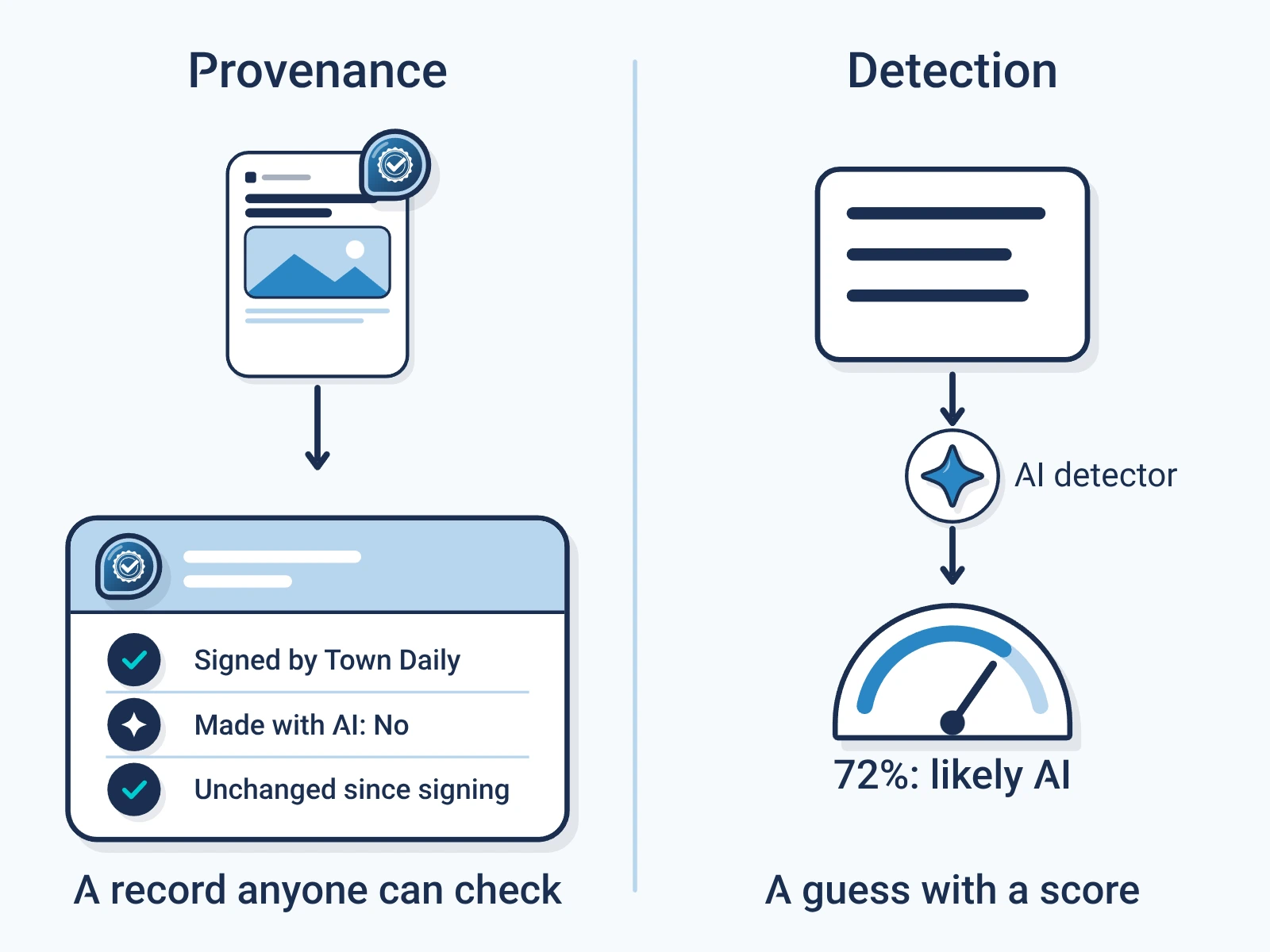
AI detection (GPTZero, Originality.ai) asks whether content was made by AI. Content provenance (Encypher) proves who made it and provides a signed receipt. These answer different questions.

Different Questions, Different Tools

The confusion between AI detection and content provenance is understandable. Both relate to content authenticity. But they address different problems from different angles.

AI detection tools like GPTZero, Originality.ai, and similar products examine the statistical properties of text to determine whether it was likely written by an AI. They look at perplexity (how predictable the word choices are), burstiness (variation in sentence complexity), and other signals that differ between human and machine writing. The output is a probability: this content is X% likely to be AI-generated.

Encypher does not detect anything. It signs. At the time an article is published, Encypher embeds a cryptographic signature in the text that records who published it, when, and what licensing terms apply. Verification later is a simple check: does the embedded signature match the claimed publisher's public key? The answer is deterministic - yes or no, not a percentage.

The Canonical Distinction

Detection asks "was this made by AI?" Provenance answers "who made this and can they prove it?"

The False Positive Problem

AI detection tools have a structural accuracy problem that limits their usefulness in high-stakes applications.

The models are trained to distinguish statistical patterns in AI-generated text from human-generated text. But human writing varies enormously. Technical writing, academic prose, legal documents, and non-native English speakers all produce text with statistical profiles that overlap with AI writing. The false positive rate - flagging human-written content as AI - ranges from roughly 5% to 26% across leading tools, depending on the content type and author background.

A 10% false positive rate sounds manageable until you apply it to a newsroom publishing 200 articles per week. At that scale, the tool generates roughly 20 false accusations per week. For an educational institution processing thousands of student submissions, the problem is worse, and the consequences - accusing a student of cheating based on a statistical guess - are serious.

The false positive problem is not a bug that will be patched. It is a consequence of the approach. Statistical classifiers trained on text characteristics will always overlap between sufficiently careful human writers and AI-generated text. The better AI models get at mimicking human writing, the higher the false positive rate goes for detection tools trained on older AI output.

After the Fact vs At Creation

Detection tools operate retrospectively. They receive a finished piece of text and analyze it. There is no chain of custody, no record of when the analysis was performed relative to when the content was created, and no way to distinguish an original from a copy.

This creates a specific vulnerability: a bad actor who wants to make human-generated content look AI-generated (or vice versa) can reverse-engineer detection heuristics and craft text accordingly. The signal is behavioral and can be gamed.

Encypher operates prospectively. The signature is created at publication, before any dispute arises. The publisher's private key signs the content hash at that moment. There is no way to retroactively forge a signature that will verify against the publisher's public key without access to the private key. The evidence is established before any adversarial action is possible.

For copyright enforcement specifically, this timing matters. A publisher who signed their article at publication and presents the signature in a dispute has evidence created before the dispute began. A publisher who runs a detection tool after discovering a suspected infringement has analysis created after the fact, which is easier to challenge.

Legal Standing

AI detection output has been challenged in legal and academic contexts. Several cases involving student plagiarism accusations and journalist investigations have shown that detection scores are not accepted as definitive proof. Detection providers themselves include disclaimers noting that results should not be the sole basis for consequential decisions.

Cryptographic signatures have a different legal history. Digital signatures are recognized under the E-SIGN Act (US), eIDAS (EU), and equivalent laws in most jurisdictions. A document signed with a cryptographic key is treated as authenticated documentation when the key management practices meet appropriate standards.

Encypher's C2PA-based signatures, embedded in published content and verifiable against the publisher's public key, are designed to serve as formal documentation of publication date, authorship, and licensing terms. When a rights violation occurs, the embedded signature enables the publisher to issue a formal legal notice documenting willful infringement - which carries statutory damages of up to $150,000 per work under US copyright law, compared to $30,000 for innocent infringement.

Side-by-Side Comparison

FeatureEncypherAI Detection Tools
What it provesWho created content and when (ownership)Whether content was likely AI-generated
When it worksAt creation (prospective)After the fact (retrospective)
Accuracy100% - deterministic pass/fail~74-95% - probabilistic estimate
False positivesNone (cryptographic)5-26% depending on content type
Proof typeCryptographic signature (ECDSA)Statistical inference
Legal standingAdmissible, formal notice capabilityDisputed, discouraged as sole evidence
Works when AI improvesYes (math doesn't change)Degrades as AI mimics human writing better
Publisher identityEmbedded, verifiableNot captured
Licensing termsMachine-readable, in the contentNot applicable
Identifies AI originPartial (AI-generated outputs can carry C2PA manifest)Yes (primary use case)
Screens submitted contentNoYes (e.g. check if contractor used AI)
Willful infringement triggerYesNo

Use Case Fit

Use detection tools when...

  • You need to screen incoming content submissions for AI use
  • Platform moderation requires identifying AI-generated content at scale
  • You need a quick check on whether specific content was likely AI-generated
  • EU AI Act requires labeling AI-generated outputs and you lack embedded markers

Use Encypher when...

  • You need to prove you created and own specific content
  • Building an evidence chain for licensing negotiations or litigation
  • You want machine-readable rights embedded in your content at publication
  • Accuracy requirements are high and false positives are unacceptable
  • Legal proceedings may require court-admissible provenance documentation

These tools address different problems and can be used alongside each other. A publisher might use detection tools to screen incoming freelancer submissions and Encypher to sign their finalized published content.

Frequently Asked Questions

What do AI detection tools like GPTZero and Originality.ai do?

AI detection tools use statistical analysis of text features - perplexity, burstiness, token probability distributions - to estimate whether content was written by an AI or a human. They produce a probability score: 'this text is 87% likely to be AI-generated.' They are trained on datasets of human and AI writing and look for patterns associated with each.

What are the false positive rates for AI detection tools?

Published research puts false positive rates for leading AI detection tools between 5% and 26%, depending on the writing style and topic. Non-native English speakers, technical writing, and academic prose are systematically flagged at higher rates. A student writing in a careful, formal style may score as AI-generated even if they wrote every word. These rates make detection tools legally contested and educationally problematic.

Is Encypher an AI detection tool?

No. Encypher is a content provenance tool. Detection tools ask 'was this made by AI?' after the fact. Encypher embeds a cryptographic signature at the time of creation that answers 'who made this and when?' The distinction is between inference applied after the fact and proof established at creation.

Can Encypher's provenance survive AI paraphrasing?

Partial survival with modification detection. If an AI paraphrases Encypher-marked content, the embedded invisible characters may survive in portions of the text depending on how the paraphrase was generated. More importantly, any surviving markers that no longer match the original content hash will fail verification - indicating the text was derived from signed content but has been modified. This modification record is itself evidence.

Can AI detection tools be used for copyright enforcement?

Generally not as primary evidence. Courts have been skeptical of statistical AI detection as evidence because of the false positive problem and the inability to pinpoint whose content was used. AI detection can tell you that something might be AI-generated. It cannot tell you which publisher's content contributed to it or prove ownership. Encypher's cryptographic approach addresses both requirements.

Should publishers use detection tools or Encypher?

These serve different purposes and can be used together. If your goal is to check whether content submitted to you (e.g., by a contractor) was AI-generated, detection tools are relevant. If your goal is to prove that your original content was used without permission - for licensing negotiations or litigation - Encypher is the appropriate tool. Detection is a screening mechanism. Provenance is a proof mechanism.

Replace probability with proof

Sign your content at publication. Verify ownership with mathematical certainty, not statistical inference.