

Cryptographic watermarking A signed mark inside the content.
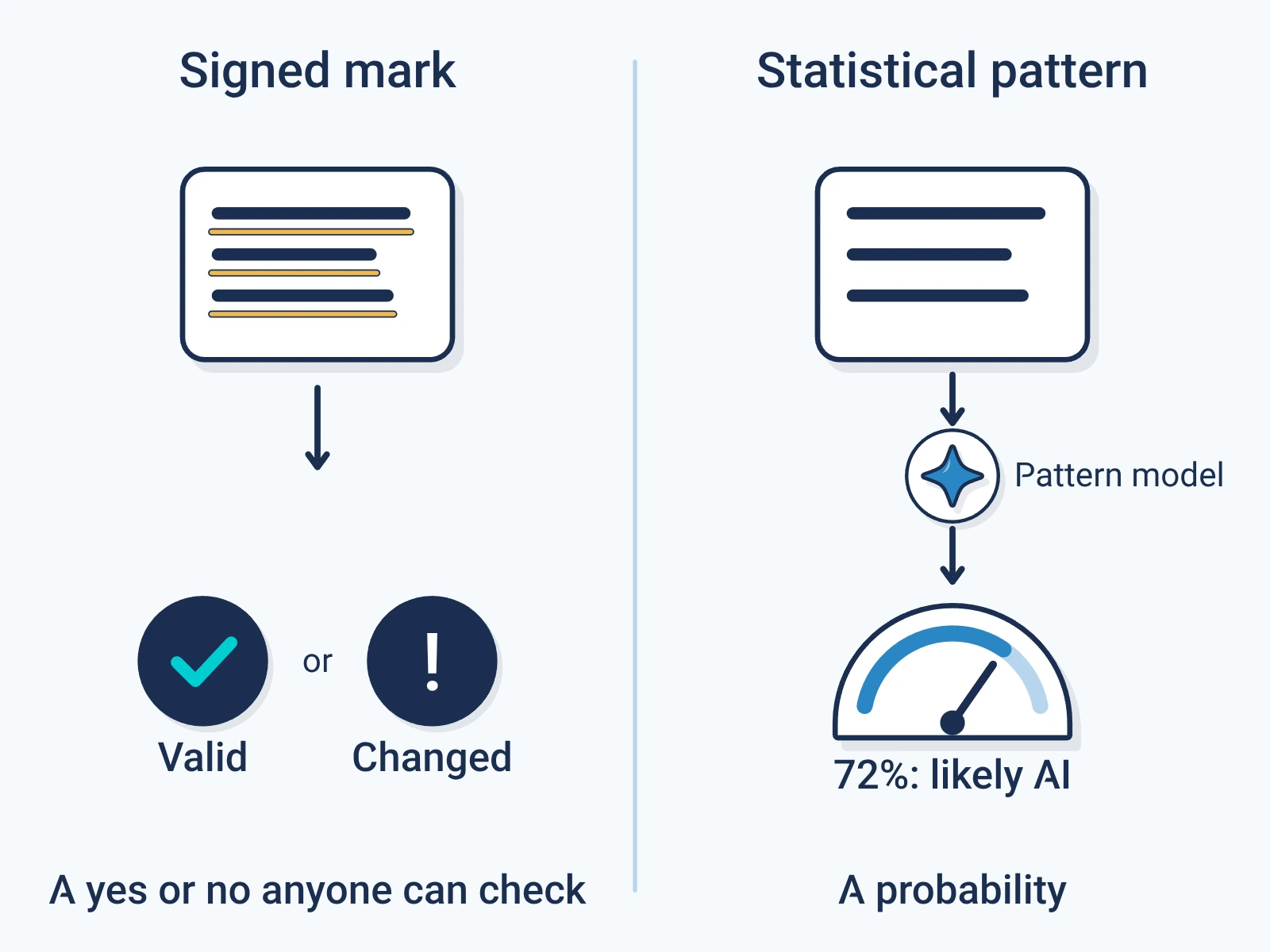
A cryptographic watermarkCryptographic watermarking: A hidden mark that carries or points to a signed record, so a check gives a yes or no rather than a likelihood. is a signed code hidden in the content itself. A checker reads it and answers yes or no: who signed it, and whether it changed since. It is a record you can check, not a guess.
- Signed
- It carries a digital signatureDigital signature: Math that shows which key signed something and that it has not changed since. Any edit to the signed bytes breaks it.. Change one word and the check fails.
- Hidden
- Readers see the same words. In text, the mark is a run of characters that draw nothing.
- Free to check
- Anyone can check it at no cost, with no account.
- Yes or no
- A check says valid, changed, or no mark found. There is no percent score.
- Not forever
- Retyping, rewriting, or a tool that strips hidden characters removes it.
Metadata, cryptographic watermark, statistical watermark
All three get called labels or marks. They answer different questions. A statistical watermarkStatistical watermarking: A hidden pattern a model adds while generating content, found later by a detector that returns a likelihood. such as SynthIDSynthID: Google DeepMind's statistical watermark, added while a model generates content and read by Google's detector. is a pattern, not a record.
| C2PA metadata | Cryptographic watermark | Statistical watermark | |
|---|---|---|---|
| Where it lives | Beside the content, as metadataMetadata: Data stored beside the content in a file, such as author, camera or date. Many tools strip it when they copy or upload a file. in the file | Inside the content, as hidden characters | Spread through the words or pixels as a pattern |
| What a check says | Valid, changed, or missing | Valid, changed, or missing | A likelihood that the pattern is there |
| Names who signed | Yes | Yes | No. It points to a model's pattern |
| A tool strips metadata | Lost | Kept, unless hidden characters are stripped too | Kept |
| Words are rewritten | Check fails | Lost for the rewritten words | Weakens. Heavy rewrites can remove it |
| Who can check | Anyone, with open tools | Anyone, free, in a public checker | The provider, with its own detector |
Encypher uses the first two together. The EU Code of PracticeCode of Practice on AI-generated content: The EU's voluntary rulebook on marking and labeling AI content, published in final form on June 10, 2026. on AI labels asks for layers like these.
Hard binding and soft binding
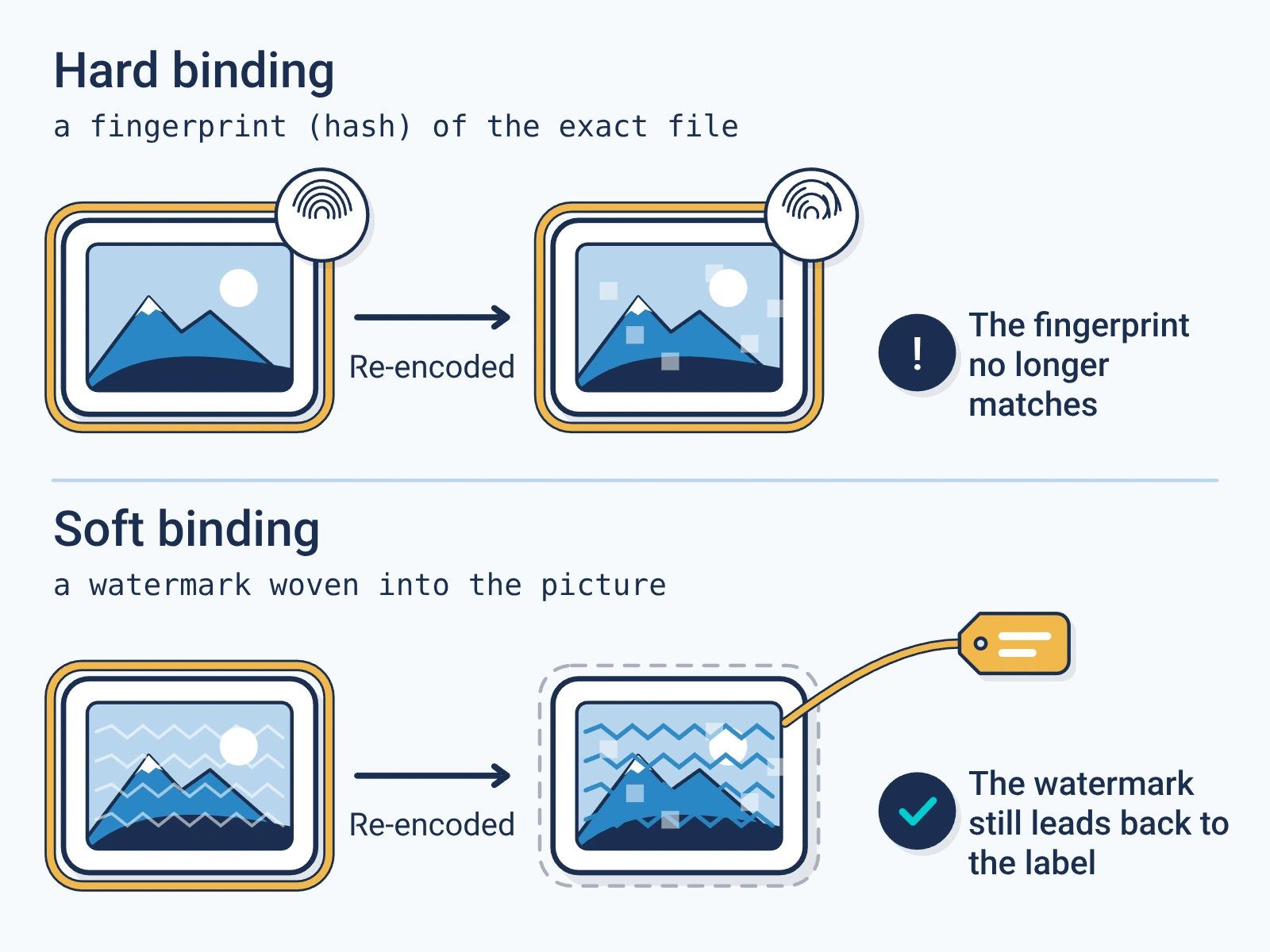
C2PAC2PA: The Coalition for Content Provenance and Authenticity: the group that publishes the open standard for content labels., the open standard for content labels, ties a label to content in two ways: a hard bindingHard binding: A hash of the content's signed bytes stored in the label, so a change to those bytes makes the check fail. and a soft bindingSoft binding: A watermark or fingerprint that can find a content label again after the file was copied or its metadata stripped..
- Hard binding
- A hashHash: A short fingerprint of exact bytes. Any change, even one character, gives a completely different hash. of the exact bytes, sealed in the signed label. A change to the hashed content fails the check. Excluded metadata and supported label updates may not.
- Soft binding
- A watermarkWatermark: A mark placed in the content itself, visible or hidden, so it can be found again after the file is copied. or fingerprintFingerprinting: Computing a compact summary of content and matching it against a database to find copies. in the content itself. It lasts through some edits and leads back to the label when the metadata is gone.
Labels in plain text
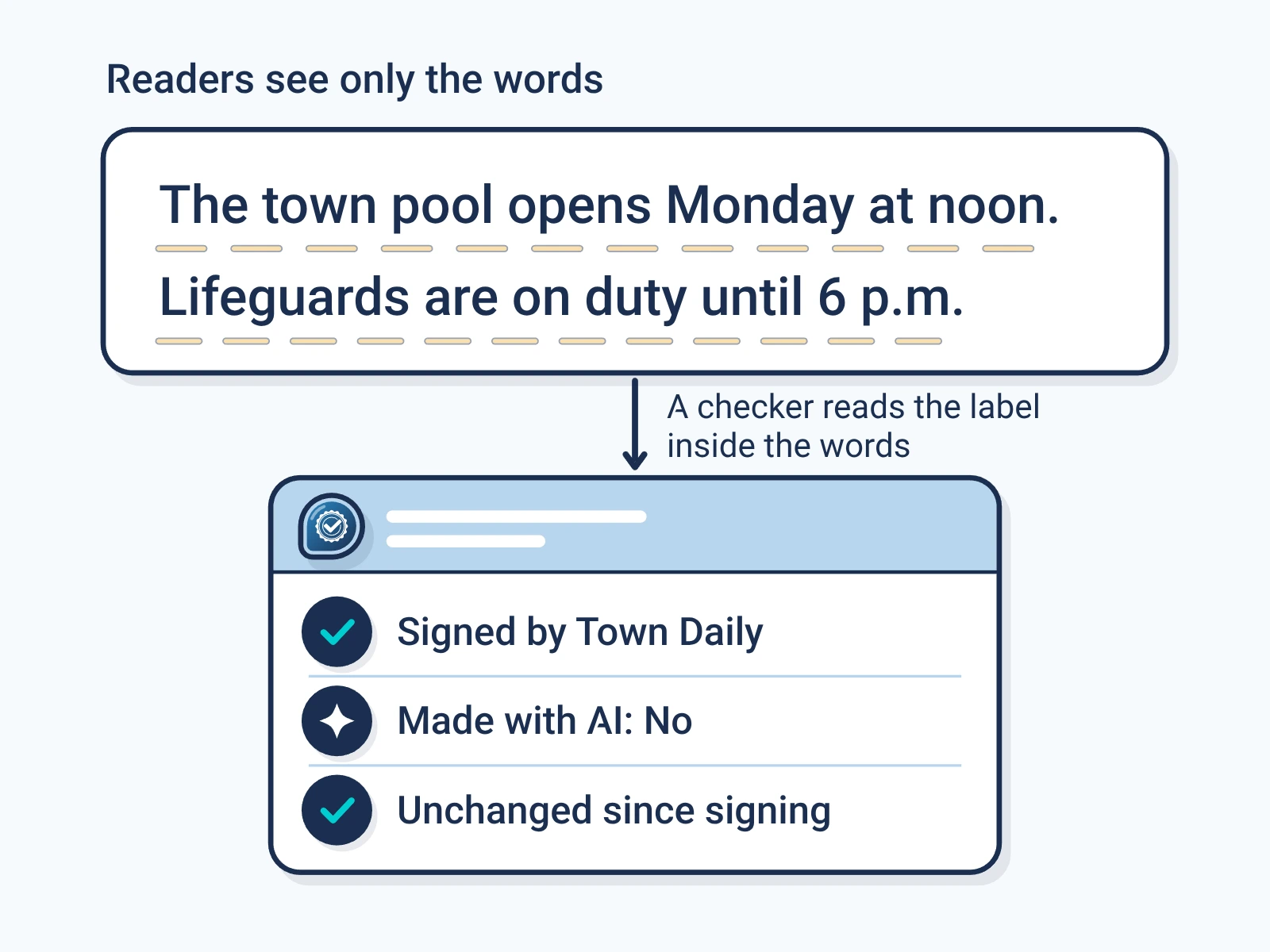
Plain text has no file wrapper to hold a label. So the signed record travels inside the text itself, in characters readers do not see. Copy the words and the label goes with them.
A quoted sentence can also be checked on its own against the signed article.
Images, audio, video and documents
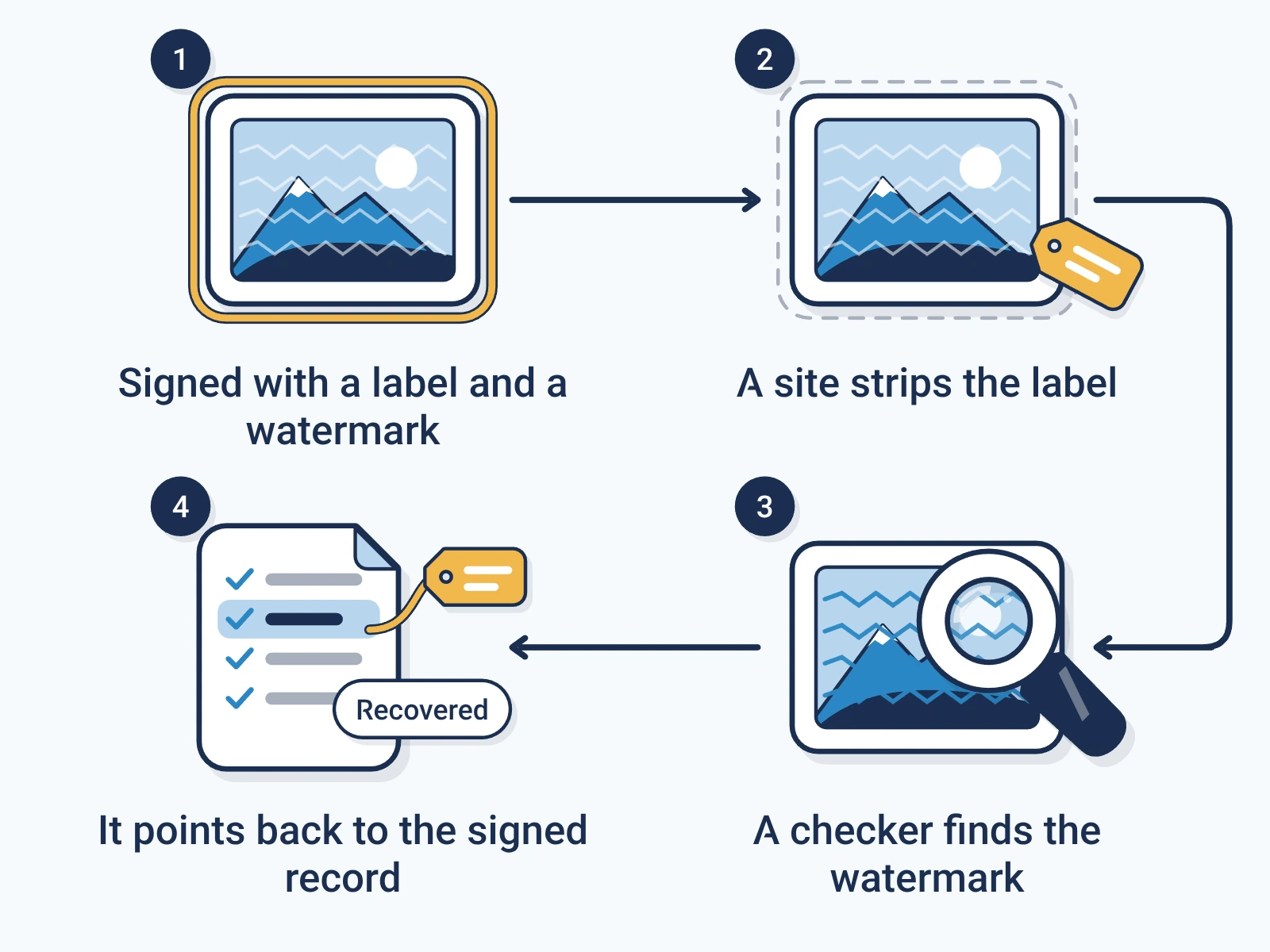
For files, including PDF and Word documents, the label is a C2PA manifestC2PA manifest: The signed label itself: a small package inside a file that records who signed it, what they declared and how to check it. stored inside the file. A hard binding ties it to the exact bytes. Some platforms strip it when they resize or re-encode. A supported watermark can then lead a checker back to the record.
Where the mark stays, and where it is lost
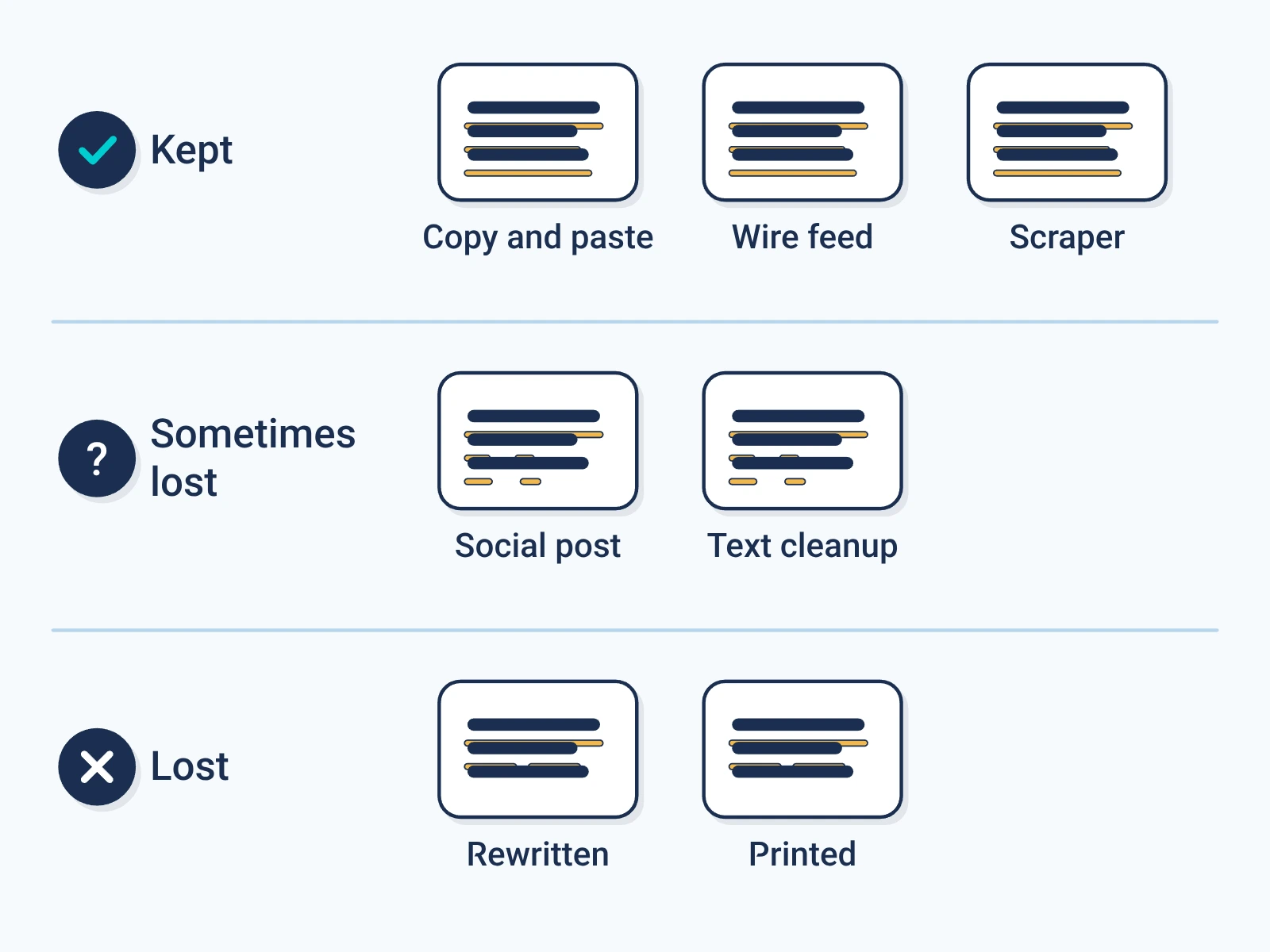
- Kept
- Copy and paste in browsers and editors, publishing in a CMS, wire feeds and web scrapers. They copy characters as they are.
- Sometimes lost
- Some email, chat and social tools strip hidden characters.
- Lost
- Retyping, paraphrasing, translating or a screenshot makes new text with no mark.
Why a signed mark matters
- AI labels
- Article 50Article 50: The EU AI Act rule that AI-made content be marked in a form software can read, and deepfakes disclosed. of the EU AI ActEU AI Act: The European Union's law on artificial intelligence, which includes rules for marking AI-made content. asks AI makers to mark output in a form machines can read. It applies from August 2, 2026, and from December 2, 2026 for systems already on sale.
Questions
What is cryptographic watermarking?
How is it different from a statistical watermark like SynthID?
Does it survive copy and paste?
For engineers
Show the technical detail
For text, the C2PA standard for unstructured textC2PA text-provenance standard: The part of the C2PA standard that puts a signed label inside plain text, using invisible Unicode characters. defines how a signed manifest is carried inside the text as invisible UnicodeUnicode: The standard that gives every character in every writing system a number, so text looks the same on every device. characters. The signature covers a hash of the visible words, so a changed word fails the check.
Encypher can also sign each sentence, so a quoted sentence can be checked against the signed article on its own. This sentence-levelSentence-level attribution: Checking that one sentence came from a specific signed source unchanged, even when it is quoted on its own. layer is patent-pending.
For files, manifests sit in JUMBFJUMBF: JPEG Universal Metadata Box Format: the container that holds a C2PA label inside a media file. boxes at the format's standard location and are signed with COSE and an X.509 certificateX.509 certificate: A digital ID card for a signing key: it names the holder and is itself signed by a certificate authority. chain. Encypher authored C2PA's standard for unstructured text, published as Section A.7 in C2PA 2.3 and carried forward as Section A.8 in C2PA 2.4.
Full technical walkthroughCreate. Mark. Endure.
Sign your first piece free, then check it in the public checker.