Encypher vs SynthID

Cryptographic content provenance vs statistical AI output watermarking. These tools address opposite problems in the content authentication space.

The Core Distinction

SynthID and Encypher are both described as "watermarking" tools, which obscures a fundamental difference in what they are actually doing. The confusion is worth resolving directly.

SynthID, developed by Google DeepMind, marks AI-generated content to identify it as machine-made. The question it answers is: "Was this content produced by an AI?" It operates on the output side of the AI pipeline, after generation has occurred.

Encypher marks human-authored content to prove it was created by a specific human or organization and to establish ownership. The question it answers is: "Who made this, when, and what are the licensing terms?" It operates on the input side, before content enters any AI system.

The Canonical Distinction

SynthID marks AI-generated output to prove it was machine-made. Encypher marks human-authored content to prove it was human-made and who owns it. These solve opposite problems.

What SynthID Does Well

SynthID solves a genuine problem: the proliferation of AI-generated content that is difficult to distinguish from human writing. For regulators, platforms, and readers who want to know whether an article, image, or audio clip was machine-generated, SynthID provides a detection mechanism.

Google has integrated SynthID across its AI products including Gemini. The tool supports text, images, audio, and video. For AI companies required under the EU AI Act Article 52 to disclose AI-generated content, SynthID is a credible implementation path.

The statistical approach also has a practical advantage: it does not require any modification to normal AI output pipelines that would be visible to end users. The watermark is woven into the token selection process during generation.

The Fragility Problem with Statistical Watermarking

Academic research on statistical text watermarking - including the method SynthID uses - has demonstrated consistent fragility. The signal is embedded by biasing token selection during generation. Removing it does not require knowing the secret key or the exact algorithm.

Three categories of attack reliably degrade or destroy statistical watermarks:

  • Paraphrasing. Rewording a passage while preserving meaning changes the token sequence, which disrupts the statistical signal. A paraphrase tool or a human editor can remove the watermark without knowing it exists.
  • Translation and back-translation. Translating to another language and back produces functionally identical content with a new token sequence. The watermark does not survive this process.
  • Targeted token substitution. Replacing a small percentage of tokens with semantically equivalent alternatives - an approach within reach of any AI system - has been shown to reduce detection rates substantially.

This is not a defect unique to SynthID. It is a fundamental property of statistical watermarking. The signal competes with the natural variation in language, and language is too flexible to hold a statistical pattern under intentional editing.

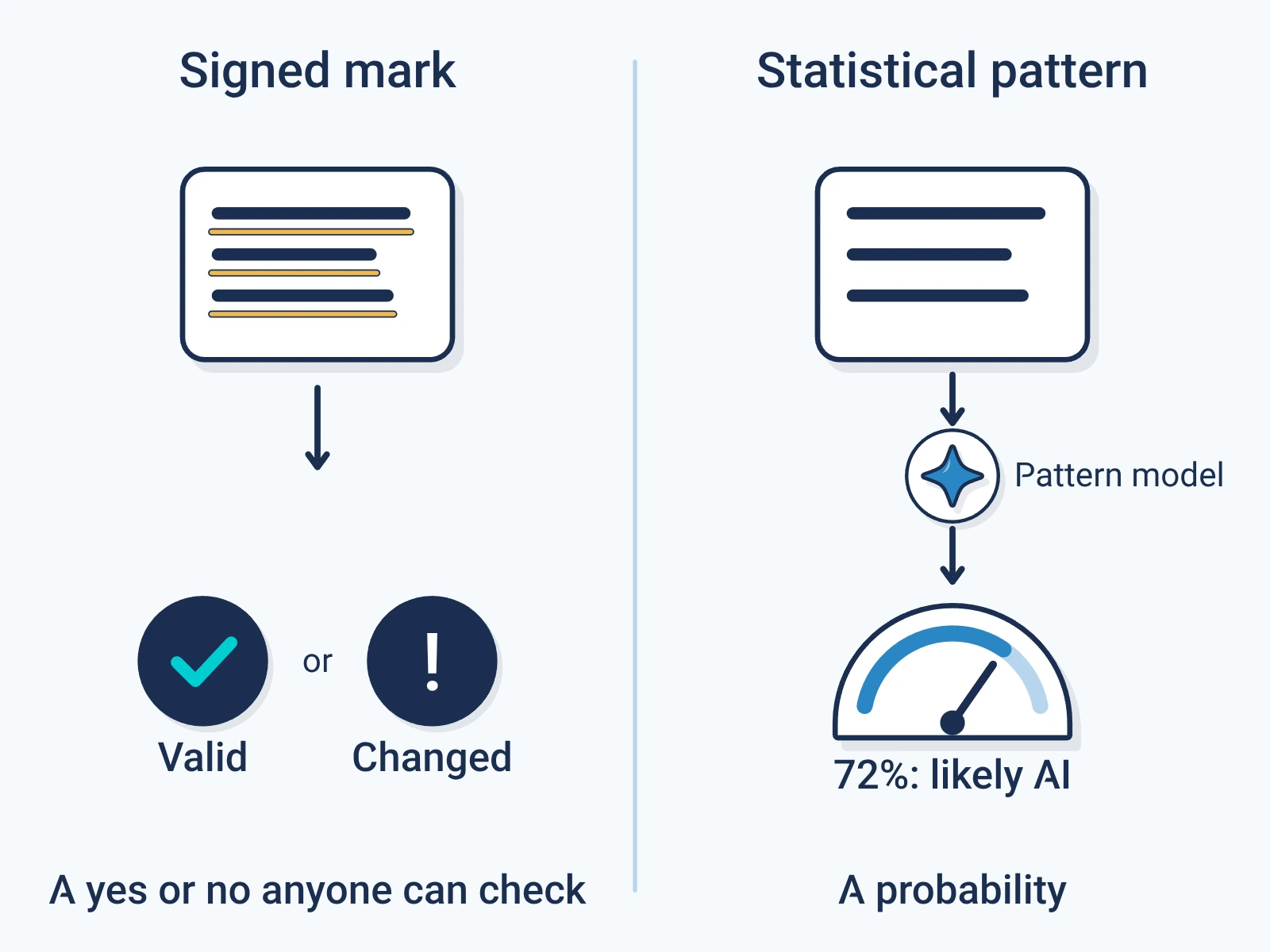
The practical consequence: SynthID reports a probability. "This content has a high likelihood of being AI-generated." For regulatory transparency disclosure, that probability may be sufficient. For copyright enforcement, where legal standing requires deterministic proof, a probability is disputed evidence.

How Encypher's Cryptographic Approach Differs

Encypher embeds a cryptographic signature invisibly within content. The signature encodes the publisher's identity, publication timestamp, content hash, and licensing terms. Verification is deterministic - a pass or fail, not a probability.

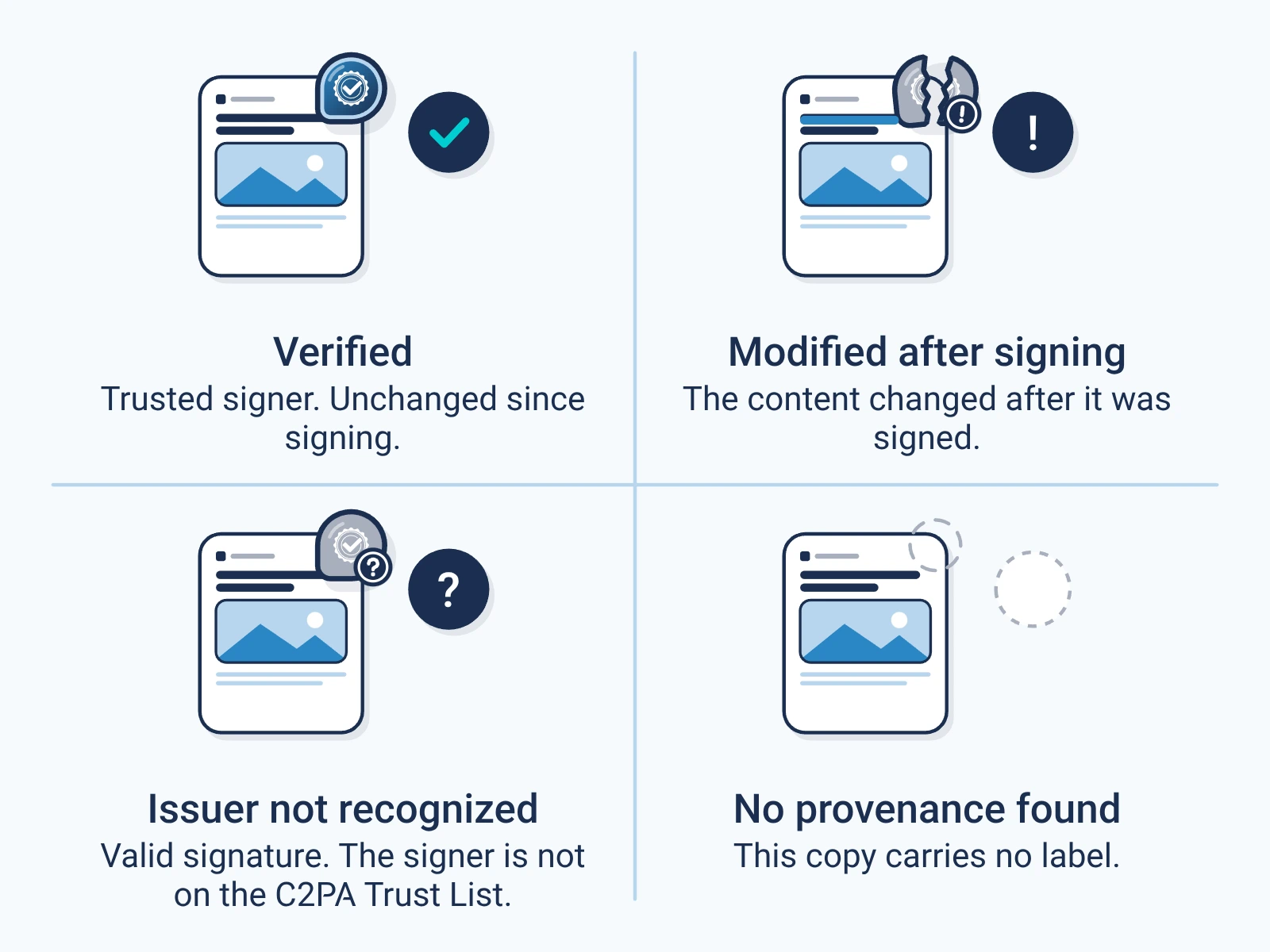
Because the signature is tied to the exact content via a cryptographic hash, any modification to the signed text is detectable: verification fails, and the failure itself indicates tampering. This is the tamper-evident property that statistical watermarks cannot provide.

The embedding survives the copy-paste operations that matter for enforcement: standard copy-paste, CMS exports, RSS syndication, web scraping. The invisible characters travel with the text. The content can move through a dozen intermediary systems and the provenance record remains intact.

The technical foundation is C2PA Section A.7, the text provenance specification that Encypher contributed to the Coalition for Content Provenance and Authenticity standard. Erik Svilich, Encypher's founder, co-chairs the C2PA Text Provenance Task Force.

Side-by-Side Comparison

FeatureEncypherSynthID (Google)
Primary purposeProve human content ownershipIdentify AI-generated output
DirectionInput-side (marks content before AI ingestion)Output-side (marks content after AI generation)
MethodCryptographic signature (ECDSA/C2PA)Statistical token-level signal
Verification resultDeterministic: valid or invalidProbabilistic: likelihood score
Survives paraphrasingYes (detects modification)No (signal degrades or is lost)
Survives copy-pasteYes (invisible chars travel with text)Yes (signal embedded in tokens)
Survives translationPartial (hash mismatch detects it)No (signal does not survive translation)
Publisher identityEmbedded in signatureNot captured
Licensing termsMachine-readable, embedded in contentNot applicable
Legal standingFormal notice capability, willful infringement triggerDisputed (probabilistic evidence)
EU AI Act Article 52Supported (C2PA manifest identifies AI-generated outputs)Supported (designed for this use case)
Open standardC2PA (200+ member organizations)Proprietary Google implementation
Vendor dependencyVerification works without Encypher serversRequires Google's detection infrastructure

Use Case Fit

Choose SynthID when...

  • You are an AI company needing to label your outputs as AI-generated
  • EU AI Act Article 52 disclosure compliance is the primary requirement
  • You are already using Google's AI infrastructure (Gemini)
  • You need to detect AI content at scale within a platform you control

Choose Encypher when...

  • You are a publisher proving ownership of human-authored content
  • You need cryptographic proof for licensing negotiations or litigation
  • You want machine-readable rights terms embedded in your content
  • You need provenance that works regardless of AI company cooperation
  • You are building an evidence chain for formal copyright notice

Note: these tools can be deployed simultaneously. They occupy different layers of the content provenance stack and address different actors (publishers vs AI companies).

Frequently Asked Questions

What is SynthID and what does it do?

SynthID is Google DeepMind's watermarking tool for AI-generated content. It embeds statistical signals into AI outputs - text, images, audio, video - to indicate that an AI system produced the content. It is designed to answer: was this made by an AI?

What is the difference between SynthID and Encypher?

SynthID marks AI-generated output to prove it was machine-made. Encypher marks human-authored content to prove it was human-made and who owns it. These are opposite problems. SynthID operates on the output side; Encypher operates on the input side. SynthID uses statistical watermarking that degrades under editing; Encypher uses cryptographic embedding that provides deterministic proof.

Is SynthID reliable enough for legal use?

SynthID uses statistical watermarking, which means detection is probabilistic. Academic research has demonstrated that paraphrasing, translation, and targeted editing can destroy the signal. The system reports a probability, not a certainty. For legal proceedings requiring deterministic proof, statistical watermarks are disputed evidence. Encypher's cryptographic approach produces a verifiable signature that is either valid or invalid - no probability involved.

Can Encypher and SynthID be used together?

Yes. They operate on different layers and serve different purposes. A publisher uses Encypher to mark their human-authored content before it enters any AI system. Google uses SynthID to mark AI-generated outputs. If an AI model trained on Encypher-marked content produces an output, SynthID might mark that output as AI-generated while Encypher's original signature in the training source proves who the source content belonged to.

Which approach is better for copyright enforcement?

Encypher. Copyright enforcement requires proving ownership of original content. SynthID proves an output was AI-generated; it says nothing about whose content was used to generate it. Encypher's cryptographic provenance proves a specific piece of content was published by a specific publisher at a specific time, establishing the ownership chain needed for licensing negotiations and litigation.

See Encypher in action

The publisher demo shows cryptographic signing and verification in under two minutes.