Encypher vs TollBit

TollBit gates the front door for AI companies that cooperate. Encypher embeds proof in your content for enforcement against everyone else. These are different layers of the same stack - both are necessary.

Placing Each Tool in the Stack

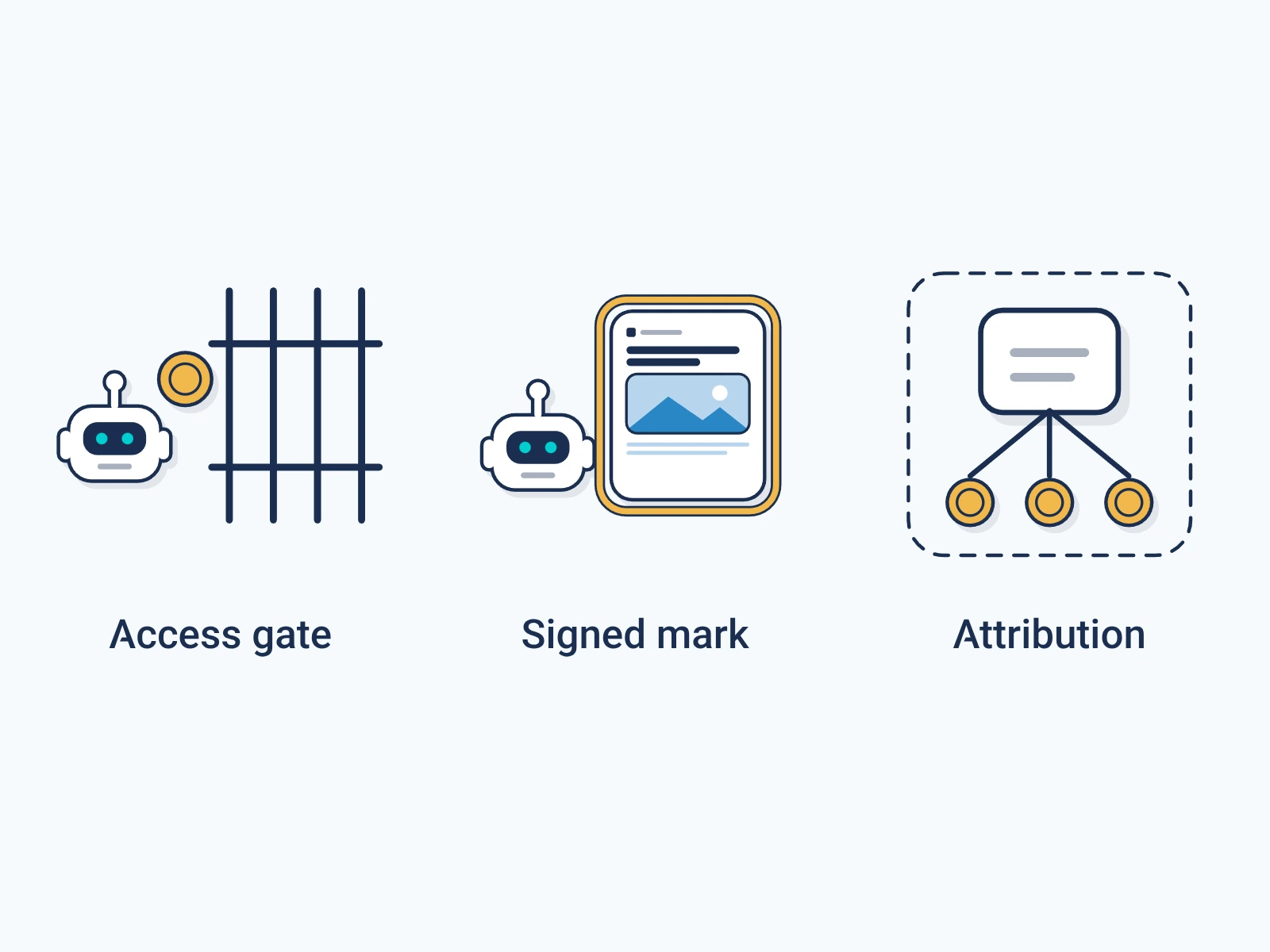
Before comparing the two products, it helps to understand where each sits in the broader content protection architecture. There are three distinct layers, and they address different actors with different approaches.

1

Layer 1: Access Control

robots.txt, TollBit, Cloudflare AI blocking. These tools sit between your server and the AI crawler. They work when AI companies follow the signals - when they send robots.txt-respecting crawlers, when they authenticate through licensing APIs. They are effective for cooperative actors and ineffective for those who bypass them.

2

Layer 2: Content Provenance (Encypher)

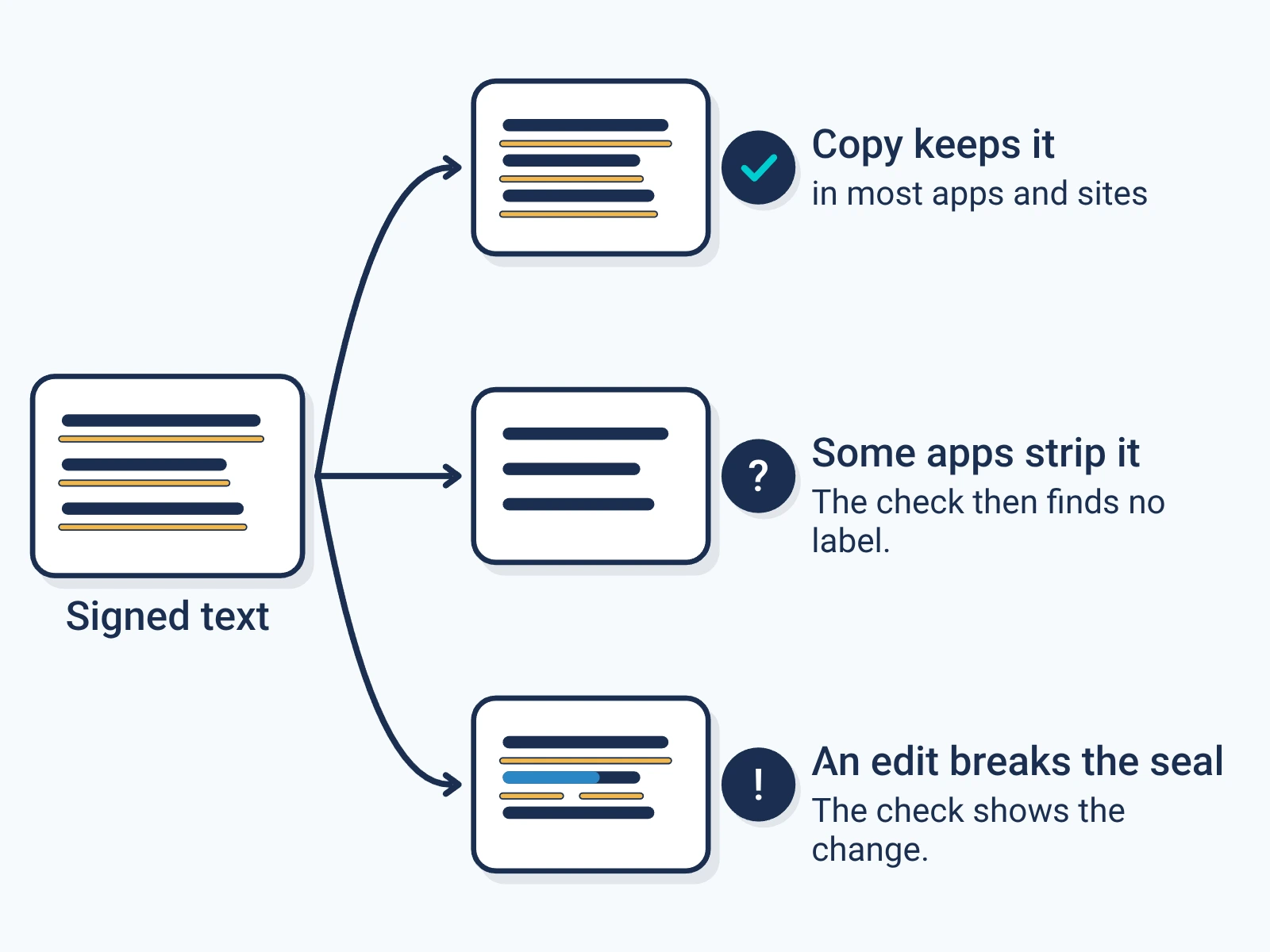
Cryptographic proof embedded in the content itself. Works regardless of how the content was obtained - through a gate, through a bypass, from a pre-existing corpus, from a downstream copy. The proof is in the text.

3

Layer 3: Attribution / Monetization

ProRata, Dappier, Microsoft PCM. These estimate which sources contributed to AI outputs and route revenue back to publishers. They operate inside systems where AI companies have opted in. No opt-in, no attribution.

The layers are complementary. A publisher who uses all three has the widest possible coverage: a cooperative licensing channel for AI companies that participate, proof embedded in content for enforcement against those who don't, and attribution revenue routing inside opted-in AI systems.

What TollBit Does Well

TollBit solves a real problem: there was no standardized mechanism for AI companies to license content from individual publishers at scale. Negotiating directly with each publisher is impractical. TollBit creates a marketplace where a publisher registers once and AI companies can license access through a single interface.

For AI companies that want to operate with clear licensing, TollBit reduces friction substantially. Instead of building bespoke licensing deals with dozens of publishers, an AI company can integrate TollBit's API and access a large catalog of licensed content with defined terms.

The tier structure - allowing publishers to set different prices for indexing, RAG, and training use cases - is commercially sensible. Training access is typically priced higher than search indexing, reflecting the different value extraction at each use.

TollBit also creates a network effect: as more AI companies integrate, publishers gain broader licensing coverage. As more publishers register, AI companies have richer licensed content catalogs available.

The Fundamental Limitation: Cooperation Dependency

TollBit's architecture depends entirely on AI companies choosing to participate. This is the correct framing, not a criticism: access gates are designed for cooperative actors. The question is what happens when cooperation is absent.

Three categories of non-cooperation are common:

  • Crawlers that bypass robots.txt and access gates. Some AI data collection pipelines do not respect these signals. A gate that is bypassed provides no protection.
  • Content already in training corpora. If an AI model was trained on your content before you implemented TollBit, the gate has no retroactive effect. The content is already inside the model.
  • AI companies that have not integrated TollBit. TollBit's licensing network covers participating companies. An AI company that builds its own crawler and has not joined TollBit's marketplace is outside the gate entirely.

None of these are unusual scenarios. Most current AI training runs predate publisher access gating infrastructure. Encypher's embedded approach addresses all three cases: the proof is in the scraped text, regardless of when scraping occurred or whether a gate was in place.

How TollBit and Encypher Work Together

The practical deployment for a publisher who wants comprehensive coverage:

  1. Register on TollBit. Set pricing tiers for indexing, RAG, and training. This creates a legitimate licensing channel for AI companies that want to cooperate. Cooperative actors get a clear path; you get revenue from willing licensees.
  2. Sign your content with Encypher. Embed provenance and machine-readable licensing terms in your published articles, retroactively across your archive and prospectively for new content. This is the enforcement layer.
  3. When cooperation is absent. If an AI company bypasses TollBit's gate and uses your content, the Encypher signature is evidence. The embedded licensing terms establish that the content was marked with rights reservations. Using the content in violation of those terms triggers willful infringement, not innocent infringement.

Encypher is not a replacement for TollBit. It is what covers the gap when TollBit's cooperative model does not apply.

Side-by-Side Comparison

FeatureEncypherTollBit
Layer in the stackLayer 2 - Content provenanceLayer 1 - Access control
Requires AI company cooperationNo - works unilaterallyYes - AI company must integrate
Works on existing training corporaYes (if content was signed pre-scrape)No (retroactive effect impossible)
Works if crawler bypasses gateYes (proof in the scraped text)No
Machine-readable licensing termsEmbedded in every documentIn TollBit's API (external)
Formal notice capabilityYes (willful infringement trigger)No
Revenue from cooperative AI companiesVia Encypher coalitionYes (primary purpose)
Works when AI company has not joinedYesNo
Proof travels with contentYesNo (gate is at the server)
Publisher integrationAPI + SDK + WordPress pluginRegistration + domain setup

Frequently Asked Questions

What does TollBit do?

TollBit is a licensing marketplace that allows AI companies to pay for access to publisher content. Publishers register their domains and set pricing for different tiers of content use (indexing, RAG, training). AI companies that want to use the content legitimately connect through TollBit's API, authenticate, pay the fee, and receive access. It functions as a front-door gate for cooperative AI companies.

What is the limitation of access gating approaches?

Access gates only work when the AI company chooses to participate. A crawler that ignores robots.txt will also ignore TollBit's gate. Content that has already been scraped and is in a training corpus bypasses any future gate. Access gating is effective for cooperative actors - AI companies that want legitimate licensing relationships. It has no mechanism for enforcement against non-cooperative actors.

How is Encypher different from TollBit?

TollBit operates at the access layer - it controls whether an AI company can reach your content. Encypher operates at the content layer - it embeds proof of ownership in the content itself. Encypher's approach works regardless of whether the AI company cooperates, because the provenance is in the text that was scraped, not in a gate that can be bypassed. These are different layers of the same stack.

Should publishers use TollBit, Encypher, or both?

Both. Use TollBit to establish a legitimate licensing channel for AI companies that want to cooperate - it reduces friction for willing partners. Use Encypher so that your content carries proof of ownership regardless of whether any given AI company used TollBit's gate. TollBit handles the cooperative relationship. Encypher handles the enforcement case when cooperation is absent.

What is the three-layer content protection stack?

Layer 1 is access control: robots.txt, TollBit, Cloudflare AI blocking. These are opt-in gates that work when AI companies follow them. Layer 2 is content provenance: Encypher. This is embedded proof in the content itself that works without AI company cooperation. Layer 3 is attribution and monetization: ProRata, Dappier, Microsoft PCM. These estimate which sources contributed to AI outputs and route revenue back - but only inside opted-in systems. The layers are complementary. None replaces the others.

Add Layer 2 to your content strategy

Access gates handle willing partners. Embedded provenance handles everyone else.