

Content provenance verification
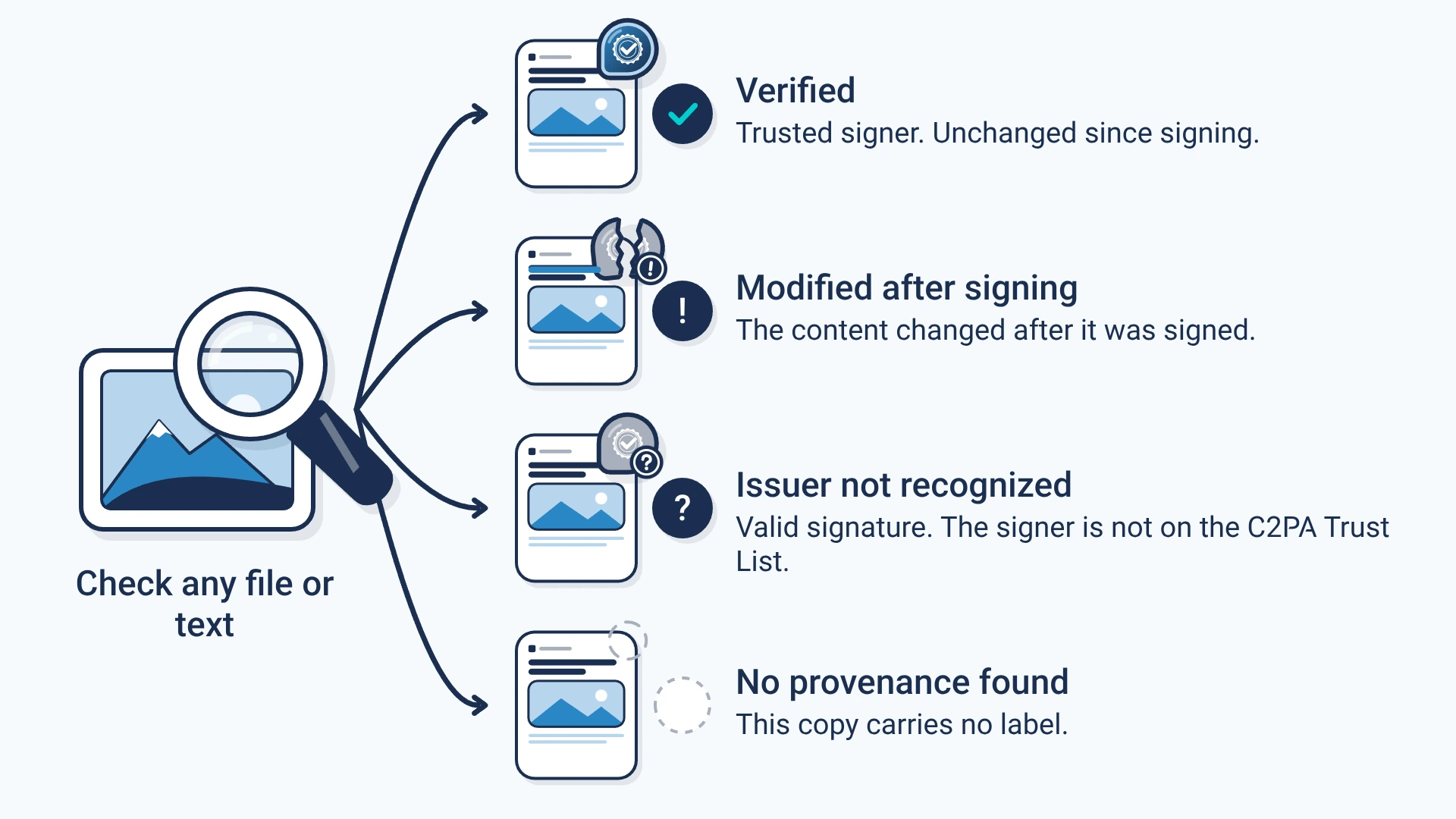
A provenanceContent provenance: The record of where a piece of content came from and how it changed, carried with the content itself. check reads the signed label in a file or text and gives one of five results. It tells you who signed, what they declared, and whether the content changed. It never says the content is true.
Signing your own work? Start free.
- Cost
- Free in the public checker. No account.
- Formats
- 79 file and media formats, including plain text.
- One check
- C2PAC2PA: The Coalition for Content Provenance and Authenticity: the group that publishes the open standard for content labels. labels, supported watermarksWatermark: A mark placed in the content itself, visible or hidden, so it can be found again after the file is copied. and recovery, each reported on its own.
- Repeatable
- Open-source libraries can repeat the same check without us.
The five results a check can give
The checker shows exactly these words.
| Result | What it means | What to do |
|---|---|---|
| Verified | Signed by a C2PA-trusted issuer. Provenance is intact. | Rely on who signed it. Read what they declared, including any AI use. |
| Valid signature, issuer not recognized | Provenance is present and intact. This issuer is not on the C2PA Trust List. | The file is intact, but the signer is not on the list checkers trust. Decide if you know them. |
| Modified after signing | This provenance does not match the current file. | Someone changed the content after it was signed. Ask the sender for the original. |
| Could not verify | The signature could not be validated. | The signature is broken or malformed. Treat the label as missing. |
| No provenance found | This file has no embedded provenance. | No label in this copy. It may never have had one, or a site stripped it. |
What a check looks at
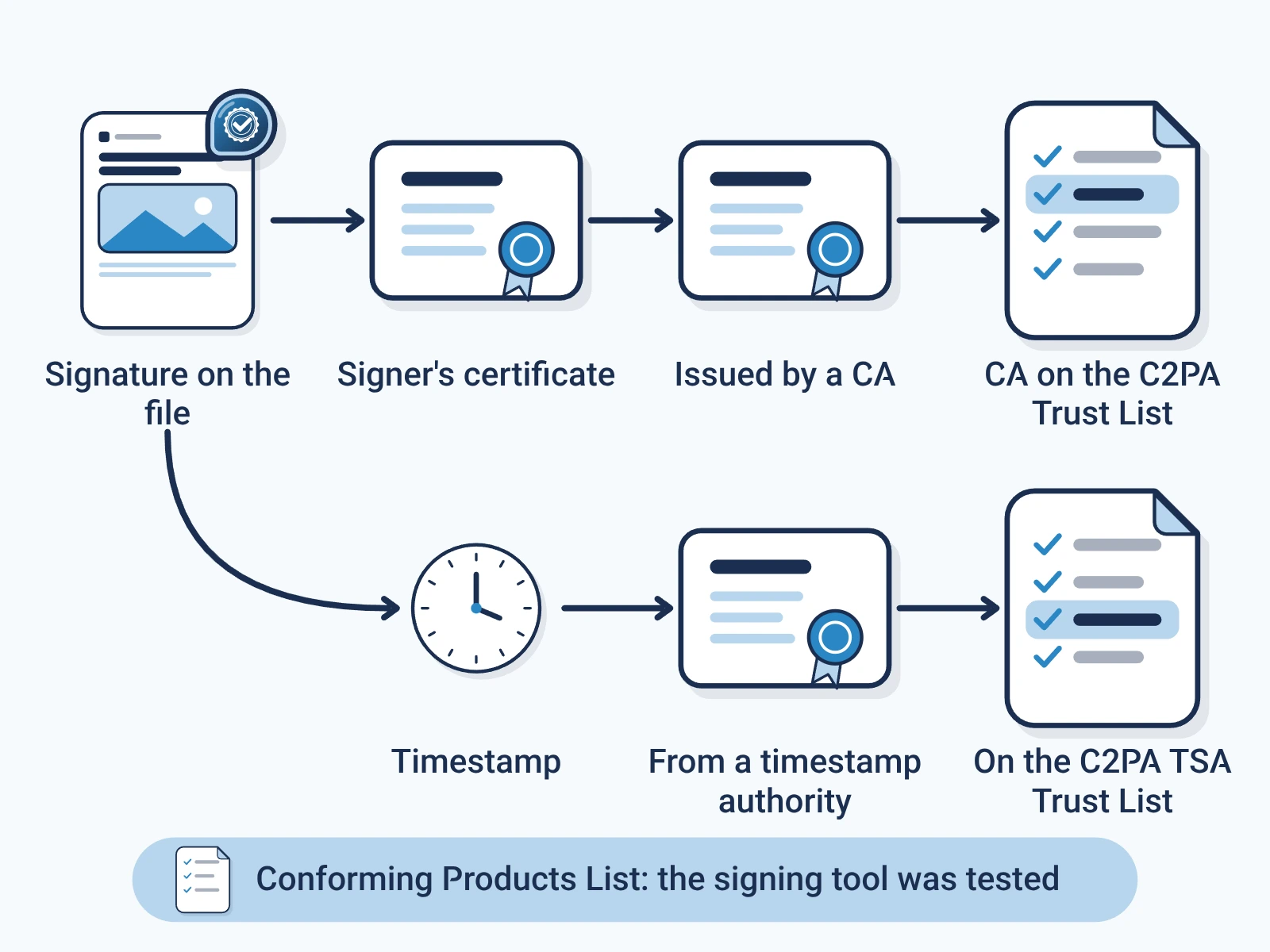
Find the label.
It reads the label from inside the file, or from the hidden characters in text.
Check the signature.
It checks the digital signatureDigital signature: Math that shows which key signed something and that it has not changed since. Any edit to the signed bytes breaks it. and whether the signer is on the C2PA Trust ListC2PA Trust List: The list of signing authorities that conforming C2PA checkers trust by default..
Compare the content.
It takes a fresh hashHash: A short fingerprint of exact bytes. Any change, even one character, gives a completely different hash., a short code worked out from the content, and compares it with the signed one.
Beyond the label in the file
One check, in the free tool or through the APIAPI: Application programming interface: a way for one program to ask another to do a job, such as sign a file., covers more than the label. Each kind of evidence keeps its own line in the result.
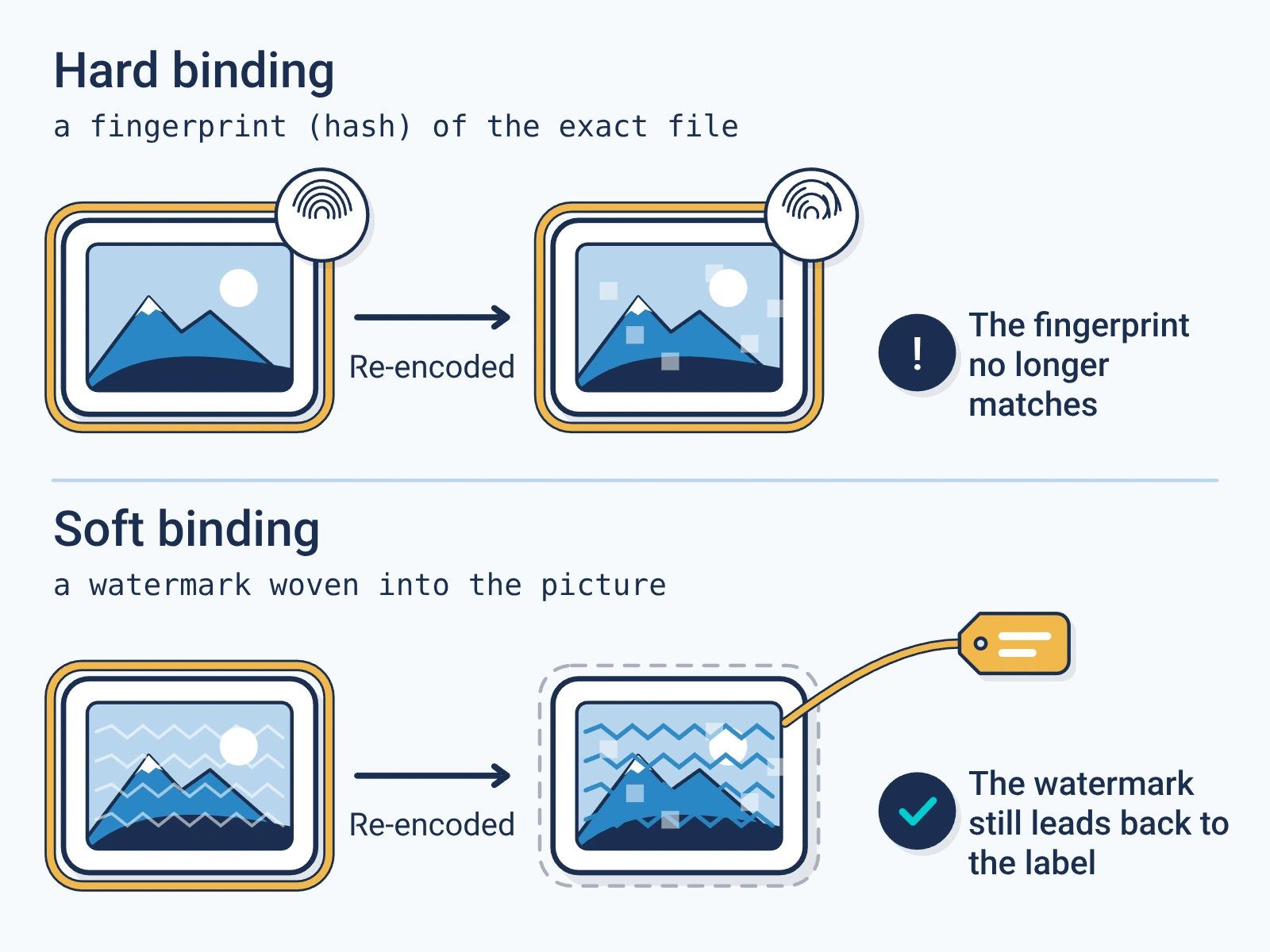
- Watermarks
- Supported text, image, audio and video marks report what was found and the limits it was tested under.
- Recovery
- If the label was stripped, a supported mark can lead back to the signed record. How recovery works
- Your policy
- Your own rules run on the evidence. They never replace the result with one vague flag.
Checking a quote from an article
For text Encypher signed sentence by sentence, a quote checkQuote integrity verification: Checking that a quoted passage, for example in an AI answer, matches the signed original word for word. confirms a single sentence. It says whether that sentence appears, unchanged, in the signed article. An AI tool can run it before it quotes a source.
Questions
Is checking free, and do I need an account?
Does a Verified result mean the content is true?
Can a check confirm one sentence from an article?
Does checking need the internet?
For engineers
Show the technical detail
How C2PA validation runs
The endpoint detects the media type and the checks that apply. It extracts the JUMBF manifest store (an APP11 segment in JPEG, a caBX chunk in PNG, a uuid box in ISO BMFF) or, for text, decodes it from the invisible Unicode characters in the text. The manifest is CBOR. The COSE signature is validated against the signer's X.509 certificate chain up to a root on the C2PA Trust List, with optional OCSP revocation checks. The hard-binding hash is then recomputed over the asset and compared. Verification is version-agnostic and the report states the spec version it validated under.
- Public check
- POST /api/v1/public/verify (text) and /api/v1/public/verify/media (files), no key.
- Open source
- c2pa-rs, with c2pa-python and c2pa-js built on it, verify manifests locally.
- Conformance
- All 79 verifiable formats are checked at the endpoint. 20 media types are in our formal C2PA conformance record, a narrower measure.
- Sentence checks
- A quote check returns the sentence and its position in the signed article.
Create. Mark. Endure.
Check a file now. It is free and needs no account.