C2PA Members: Who Is Building the Standard
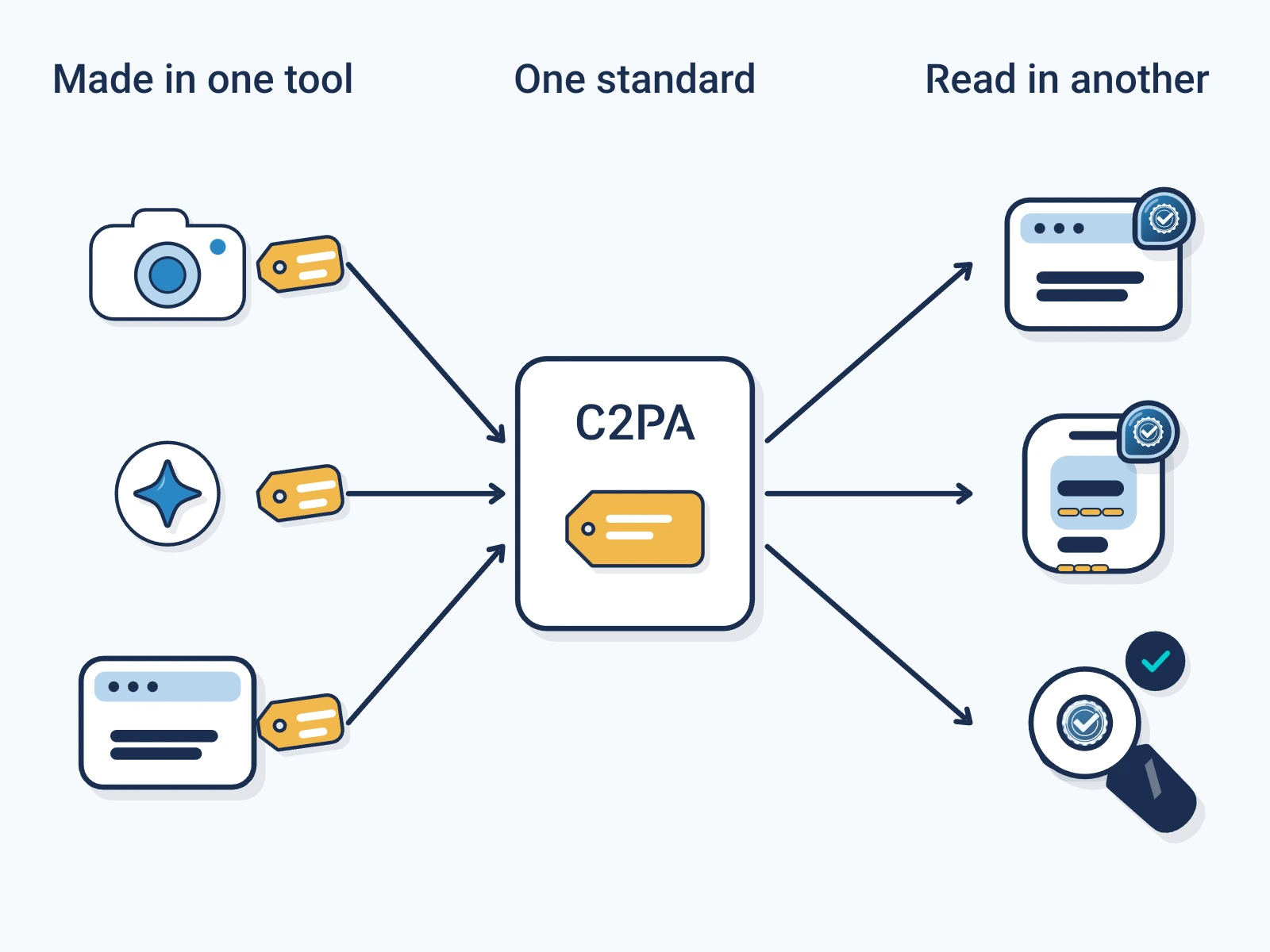
Over 200 organizations building content provenance infrastructure together. Technology companies, media organizations, camera manufacturers, and AI labs. The breadth of membership is what makes C2PA viable as internet-scale infrastructure.
Founding and Steering Members
C2PA was founded in 2021 as a joint effort by Adobe, Arm, BBC, Intel, Microsoft, and the Content Authenticity Initiative. These organizations recognized that content provenance required an open standard with broad industry support - no single vendor's solution would achieve the network effects needed for verification to work across the internet.
The founding logic was straightforward: for provenance to be useful, recipients of content need to be able to verify it without trusting the content's creator. That requires an open standard with open verification tools, so any party can independently confirm provenance claims. A proprietary standard controlled by one company creates a trust dependency that defeats the purpose.
Since founding, the steering committee has expanded to include AP (Associated Press), Reuters, the BBC, The New York Times, Google, Sony, Nikon, Canon, Leica, Qualcomm, and many others across the content and technology ecosystem.
Member Categories
Technology Platforms
Adobe, Microsoft, Google, Intel, Arm, Qualcomm, and others contribute to the core specification and reference implementations. Adobe's Content Credentials product is built on C2PA. Microsoft is implementing C2PA in its AI content generation tools. Google is implementing C2PA in its image generation and YouTube systems.
Platform participation means provenance infrastructure is built into the tools that creators use. When Photoshop exports an image with C2PA provenance, every Photoshop user inherits the capability.
AI Companies
OpenAI is a C2PA member. This is significant: the company whose AI systems are generating content at the largest scale has joined the standard that documents what content is AI-generated and what is not. OpenAI's participation signals that content provenance is understood as infrastructure, not as adversarial documentation.
AI company membership in C2PA creates the conditions for cooperative content provenance: AI companies that generate content mark it with C2PA, and publishers whose content is used by AI companies can embed provenance that travels into training corpora. Both directions use the same standard.
News Organizations and Publishers
AP, Reuters, BBC, and The New York Times are C2PA members. These organizations distribute content to hundreds or thousands of downstream recipients. Their participation means that provenance is being embedded at the point of maximum distribution: when wire service content travels to subscriber outlets worldwide, it can now carry C2PA manifests.
For publishers downstream from these wire services, C2PA membership means receiving signed content that they can verify before publication. A regional outlet receiving AP content with C2PA provenance can confirm the content came from AP and has not been modified in transit.
Camera Manufacturers
Sony, Nikon, Canon, and Leica are C2PA members. Several of these manufacturers have already shipped cameras with C2PA signing capabilities built into the hardware. A photo taken on a C2PA-enabled camera carries a manifest signed by the camera itself, recording the capture device, GPS coordinates, and capture timestamp.
Camera-level signing is the gold standard for photographic provenance. The manifest is created at the moment of capture, before any post-processing, and is signed by a hardware key embedded in the camera. No amount of editing can retrofit a legitimate capture manifest.
Task Force Structure
C2PA organizes technical work through task forces, each responsible for a specific area of the specification. The current task forces cover text provenance, audio/video provenance, identity and credentials, software applications, and implementation guidance.
Erik Svilich, Encypher's founder, co-chairs the Text Provenance Task Force. This task force is responsible for Section A.7 of the C2PA specification, which defines how text content carries C2PA manifests. The task force maintains the specification, addresses implementation questions, and extends the standard as text provenance requirements evolve.
Co-chair status reflects active contribution to the specification, not just membership participation. Encypher's contribution to C2PA is substantive: the text provenance section did not exist in earlier C2PA versions and was added through the work of the Text Provenance Task Force.
Why Membership Scale Matters for Publishers
The value of a provenance standard scales with the number of parties that implement it. A standard with 10 members can document provenance in 10 contexts. A standard with 200 members - including the major platforms, AI companies, news wire services, and camera manufacturers - can document provenance at internet scale.
For publishers, the relevant question is whether the AI companies and platforms they interact with will honor C2PA provenance. The answer depends on whether those companies participate in the standard. The C2PA membership list includes the companies whose participation matters: Adobe, Google, Microsoft, OpenAI, and the major news wire services.
This is not a guarantee that all C2PA members honor provenance in every context. It is a signal that the standard has the critical mass to become the industry default. Verification tools built by C2PA members work on all C2PA-signed content, regardless of who signed it. This interoperability is the practical consequence of broad membership.
Publishers who sign their content with C2PA today are building provenance into a system that is increasingly supported by the major distribution and consumption platforms. The provenance they embed today will be verifiable by tools those platforms deploy tomorrow.
Encypher's Role in C2PA
Encypher is a C2PA member organization. Beyond membership, Encypher contributed Section A.7 (text provenance) to the C2PA 2.3 specification and co-chairs the Text Provenance Task Force through Erik Svilich.
This contribution means that the text provenance standard reflects Encypher's technical expertise. The encoding approaches defined in Section A.7 are the approaches that Encypher implements in its API.
Encypher also extends the C2PA standard with proprietary capabilities that build on the open foundation: sentence-level authentication, distribution fingerprinting, and attribution search. These extensions are compatible with the C2PA standard (they do not break standard verification) while providing additional capabilities not defined in the current specification.
Related Resources
Build on the Industry Standard
C2PA is the standard that Adobe, Microsoft, Google, and OpenAI all support. Encypher implements it with extensions for text provenance at sentence granularity.