

The C2PA standard for text
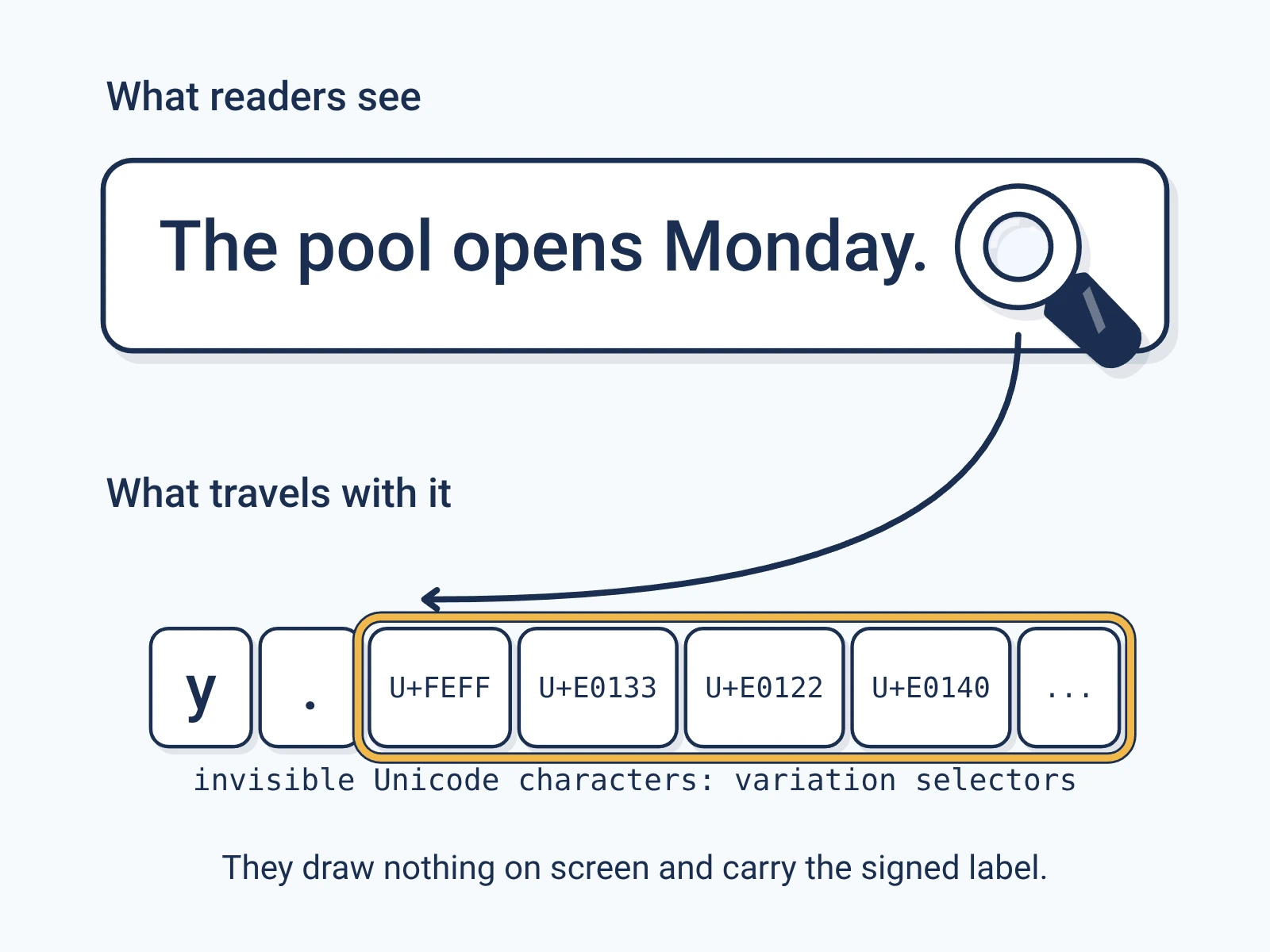
Articles and posts have no file box to hold a label. This part of C2PAC2PA: The Coalition for Content Provenance and Authenticity: the group that publishes the open standard for content labels. hides the signed label in the text itself, in characters that draw nothing on screen.
- Published
- C2PA 2.3C2PA 2.3: The version of the C2PA specification, published January 8, 2026, that added the standard for unstructured text., January 8, 2026, as Section A.7C2PA text-provenance standard: The part of the C2PA standard that puts a signed label inside plain text, using invisible Unicode characters..
- Now
- Section A.8 of C2PA 2.4. The method is the same.
- Author
- Encypher. Erik Svilich co-chairs the C2PA Text ProvenanceText provenance: A signed label for text: who signed it, when, and whether the words changed. Task Force.
- Result
- Pass or fail. No score and no guess.
How a label hides in text
Encypher authored C2PA's standard for unstructured text, published as Section A.7 in C2PA 2.3 and carried forward as Section A.8 in C2PA 2.4.
Files such as photos have a spot set aside for extra data. Unstructured textUnstructured text: Text with no file around it, such as an article body, a post or a chat reply, so there is no container to hold a label. does not. So the label has to live in the letters.
The standard defines one encoding. It turns the signed manifestC2PA manifest: The signed label itself: a small package inside a file that records who signed it, what they declared and how to check it. into a run of invisible UnicodeUnicode: The standard that gives every character in every writing system a number, so text looks the same on every device. characters that carry data but draw nothing on screen. Signed text looks the same as unsigned text.
Where the label stays, and where it is lost
The sentence The pool opens Monday appears on a card with a gold stitch under it, labeled Signed text. One copy drops into an app window and keeps its stitch; a check mark appears: This app keeps it. A second copy drops into another app and its stitch fades away; a question mark appears: This app strips it.
- Copy and paste keeps it, and so do email and most sites.
- Some tools delete hidden characters. Test your own path, and ask partners to keep labels.
- Change one word and the seal breaks. The check then says the text changed.
California's AI Transparency Act also covers these labels. Read the California guide.
What Encypher adds on top
| The standard | Encypher adds | |
|---|---|---|
| What one label covers | The whole text. | Each sentence, through sentence-level attributionSentence-level attribution: Checking that one sentence came from a specific signed source unchanged, even when it is quoted on its own.. |
| How it is stored | Invisible Unicode characters. | A Word-safe option for text edited in Microsoft Word. |
| Who can check it | Any C2PA checker that reads text. | Encypher's verifier, for sentence checks. |
The Word-safe option is Encypher's addition, not part of the standard. Per-sentence labels are also ours. Text we sign still passes a standard whole-text check.
Check text signed either way with Encypher's free verifier.
Who keeps it current
The C2PA Text Provenance Task Force maintains this part of the standard. Erik Svilich, Encypher's founder, co-chairs it. The group answers questions from people who build it and extends it as needs change.
The text is free to read in the C2PA 2.3 specification.
For engineers
Show the technical detail
The encoding
- The manifest store (JUMBF) is wrapped in a C2PATextManifestWrapper.
- The wrapper is written into the text as invisible Unicode characters, as the specification defines.
- The hard binding hashes the text with the wrapper left out, so any edit to the visible text breaks the match.
- The encoding is deterministic: one manifest always gives the same characters, and back.
Section numbers
C2PA 2.4 renumbered the text appendices. A.7 now covers HTML, A.8 covers unstructured text, and A.9 covers structured text. The method Encypher authored is A.7 in C2PA 2.3 and A.8 in C2PA 2.4.
Encypher options
Encypher can also sign each sentence, so one sentence can be checked alone, and offers a Word-safe option for text edited in Microsoft Word. Both are set per request in the signing API.