

C2PA and SynthID: a label and a watermark.
C2PAC2PA: The Coalition for Content Provenance and Authenticity: the group that publishes the open standard for content labels. is a signed label that shows who signed the label and what they declared. SynthIDSynthID: Google DeepMind's statistical watermark, added while a model generates content and read by Google's detector. is Google's hidden watermark for AI output. They answer different questions, so many teams use both.
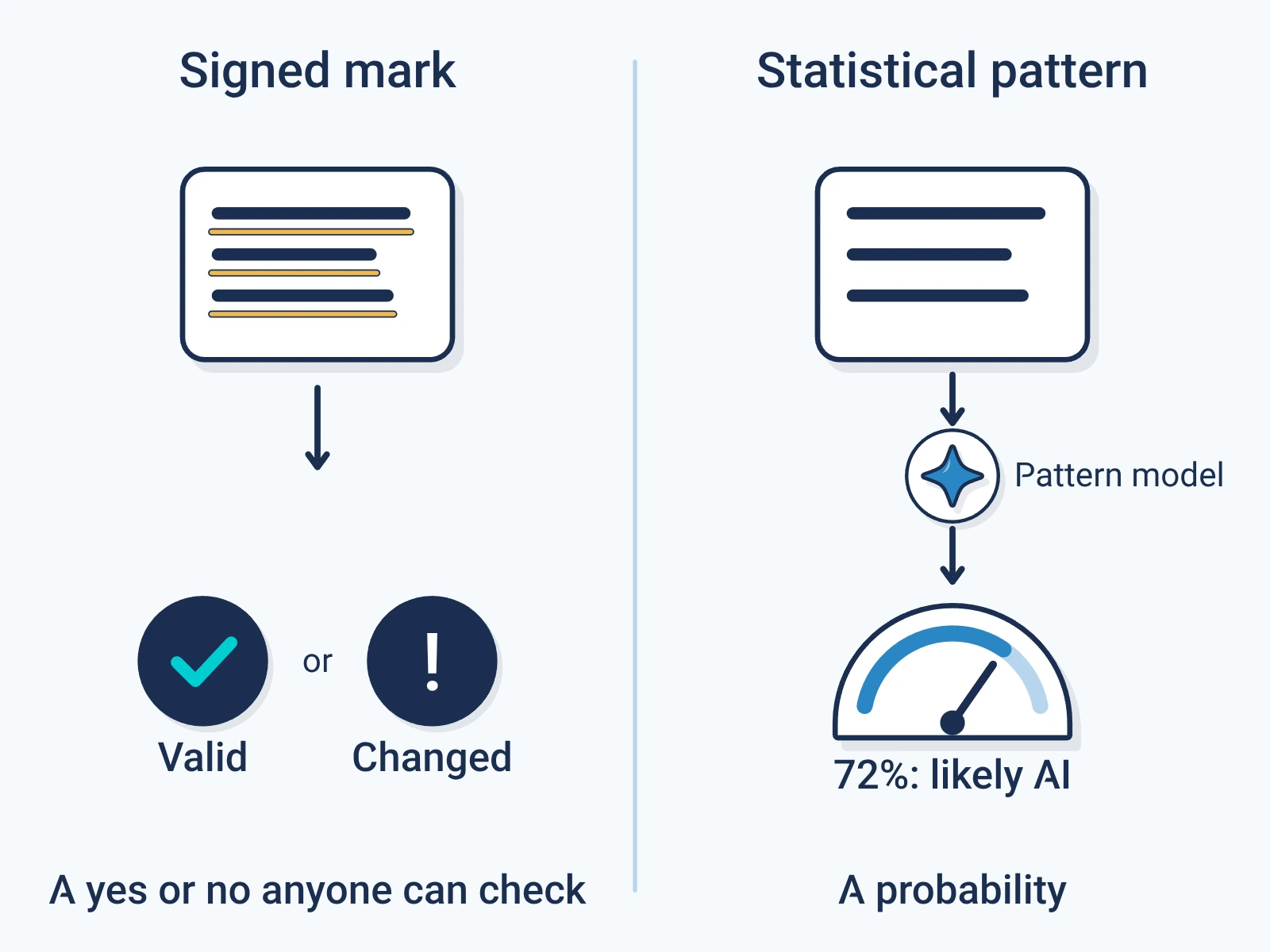
C2PA and SynthID, side by side
| C2PA label | SynthID watermark | |
|---|---|---|
| What it is | A signed record stored with the file. | A statistical watermarkStatistical watermarking: A hidden pattern a model adds while generating content, found later by a detector that returns a likelihood. in the pixels, sound or words. |
| Who adds it | Any signer with a certificate. | Google models and tools that use SynthID. |
| What it tells you | Who signed, what they declared, and if it changed. | That a SynthID model likely made it. |
| The answer | Pass or fail. | A likelihood. |
| Who can check | Any C2PA checker, with open code. | Google's tools. Encypher checks only marks it applied itself. |
| After edits | A change to bytes covered by the hard bindingHard binding: A hash of the content's signed bytes stored in the label, so a change to those bytes makes the check fail. breaks the match. Some apps strip it. | Survives light edits. Heavy rewrites weaken it. |
| Standard | Open: C2PA 2.4, 400+ members. | Google technology. |
When to use each
- Use C2PA
- To show who signed a file, what they declared, and whether covered content changed.
- Use SynthID
- When you make content with a Google model and want a mark in the content itself.
- Use both
- For Article 50Article 50: The EU AI Act rule that AI-made content be marked in a form software can read, and deepfakes disclosed. of the EU AI ActEU AI Act: The European Union's law on artificial intelligence, which includes rules for marking AI-made content.. The Code of PracticeCode of Practice on AI-generated content: The EU's voluntary rulebook on marking and labeling AI content, published in final form on June 10, 2026. calls for layers: a signed label and a hidden watermark.
Where Encypher fits
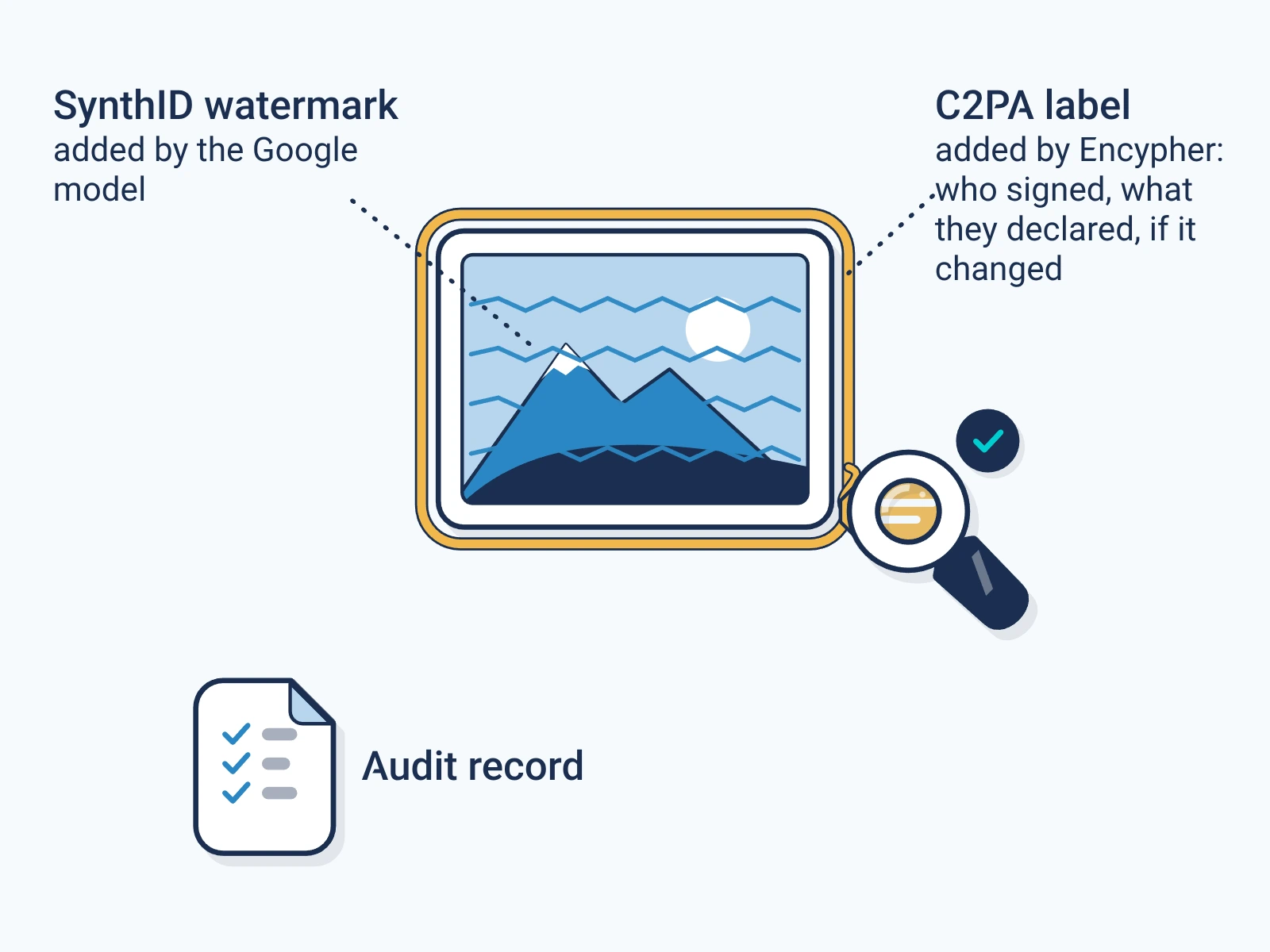
Encypher supports SynthID text watermarkingWatermark: A mark placed in the content itself, visible or hidden, so it can be found again after the file is copied.. SynthID supplies the watermark. Encypher adds the signed C2PA label and the audit record around it.
Encypher's checker reads C2PA labels. It can also check SynthID marks that Encypher applied itself. It cannot read SynthID marks applied by Google or anyone else.
For engineers
Show the technical detail
How SynthID marks text
SynthID Text changes token sampling during generation with a keyed function, so the choice of words carries a pattern. A detector scores how likely the pattern is present. Google has open-sourced SynthID Text in Hugging Face Transformers.
How C2PA binds to content
A C2PA manifest uses a hard binding: a hash of the content inside a COSE-signed claim. Verification is deterministic. C2PA 2.x also defines soft-binding assertions, so a watermark can point back to a manifest that was stripped from the file.
Keep results separate
- Store the C2PA validation result and any watermark detection as separate fields.
- Never turn a watermark likelihood into a pass, or a C2PA pass into a claim about which model made the content.