

Cryptographic vs statistical watermarking
A cryptographic watermarkCryptographic watermarking: A hidden mark that carries or points to a signed record, so a check gives a yes or no rather than a likelihood. is a signed record, and a check says valid, changed or missing. A statistical watermarkStatistical watermarking: A hidden pattern a model adds while generating content, found later by a detector that returns a likelihood. is a pattern a model leaves as it writes, and a detector says how likely it is there. They answer different questions.
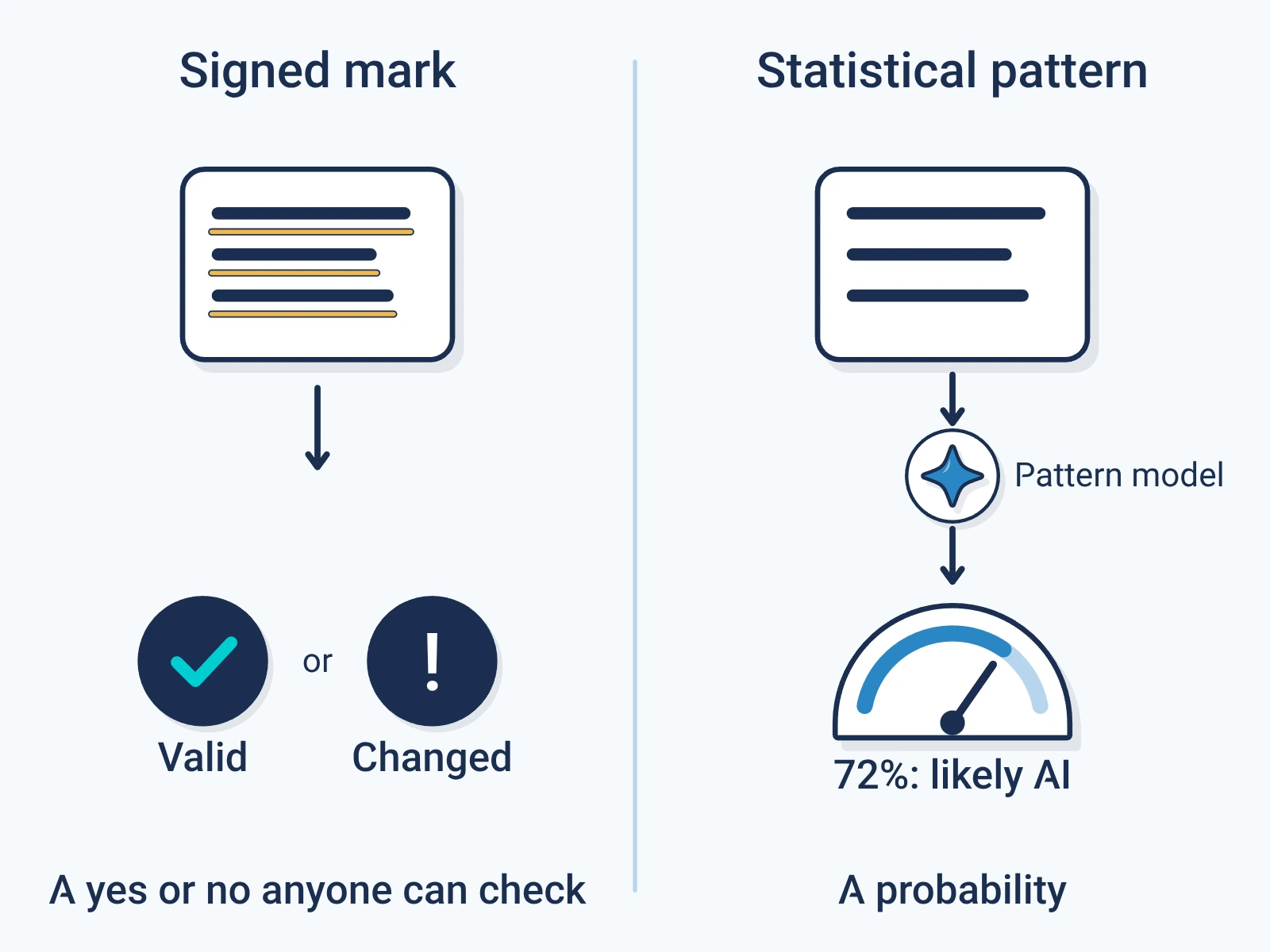
Side by side
| Cryptographic watermark | Statistical watermark | |
|---|---|---|
| What it is | A signed record in invisible markersProvenance markers: Encypher's general name for invisible characters that carry a signed label inside text. | A pattern added while a model generates |
| Example | Encypher text marks | Google DeepMind's SynthIDSynthID: Google DeepMind's statistical watermark, added while a model generates content and read by Google's detector. |
| Added by | Whoever signs, any time after the work exists | The model, while it generates |
| What a check says | Valid, changed or no mark | How likely the pattern is there |
| Names who signed | Yes | No. It shows which model's pattern |
| Human-written work | Can be signed | Not covered. It marks model output |
| Light edits | The edited sentences fail the check | The pattern usually holds |
| Rewrite or translation | Lost | Weakens and can be lost |
| Who can check | Anyone, free | Whoever holds the watermark keys |
When to use each
- Cryptographic
- To show who signed a piece, that it is unchanged, and which terms came with it. Works on human and AI work.
- Statistical
- To flag output from a model even when no one signed it. The model maker has to build it in.
- Both
- The EU Code of PracticeCode of Practice on AI-generated content: The EU's voluntary rulebook on marking and labeling AI content, published in final form on June 10, 2026. asks for layers. SynthID can supply the watermarkWatermark: A mark placed in the content itself, visible or hidden, so it can be found again after the file is copied., and Encypher adds the signed C2PAC2PA: The Coalition for Content Provenance and Authenticity: the group that publishes the open standard for content labels. label and the evidence around it.
A missing mark, a faked mark
- Statistical
- A weak or missing pattern gives a low score. A score is an estimate, so an expert can dispute it either way.
- Cryptographic
- A copy with no mark checks as unsigned. A valid mark cannot be made without the signer's private keyPublic key cryptography: Signing with a secret private key that only the signer holds, checked by anyone with the matching public key., so no one else can make content check as signed by you.
Record or estimate
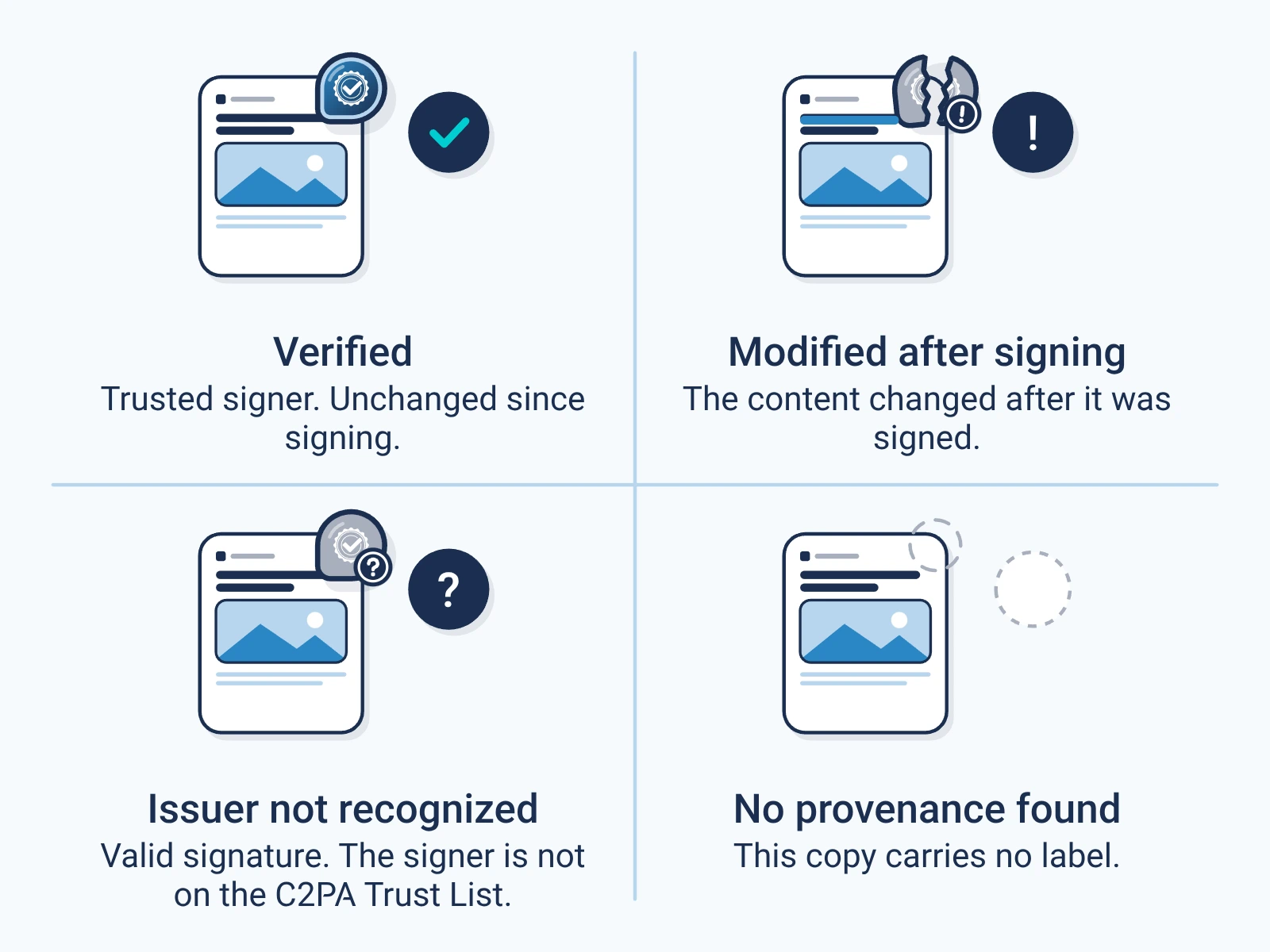
A signed record shows who signed, when, and whether the content changed. A likelihood score is an estimate an expert can dispute. How much weight either carries in a dispute is for counsel and the court to decide.
For engineers
Show the technical detail
SynthID Text nudges token sampling with a keyed function during generation. Its detector scores a passage against the same keys. Google publishes the text method as open source (documentation). For images and audio, the signal sits in the pixels or the waveform.
A cryptographic mark binds a signed claim to a hashHash: A short fingerprint of exact bytes. Any change, even one character, gives a completely different hash. of the content. The claim is signed with COSE and an X.509 certificate chain, and checked by the algorithm in the open C2PA specification. A hash mismatch reports a change. A missing marker reports no mark.
Create. Mark. Endure.
Check any file or text free. Each signal is reported on its own.