Content Provenance vs. Content Detection
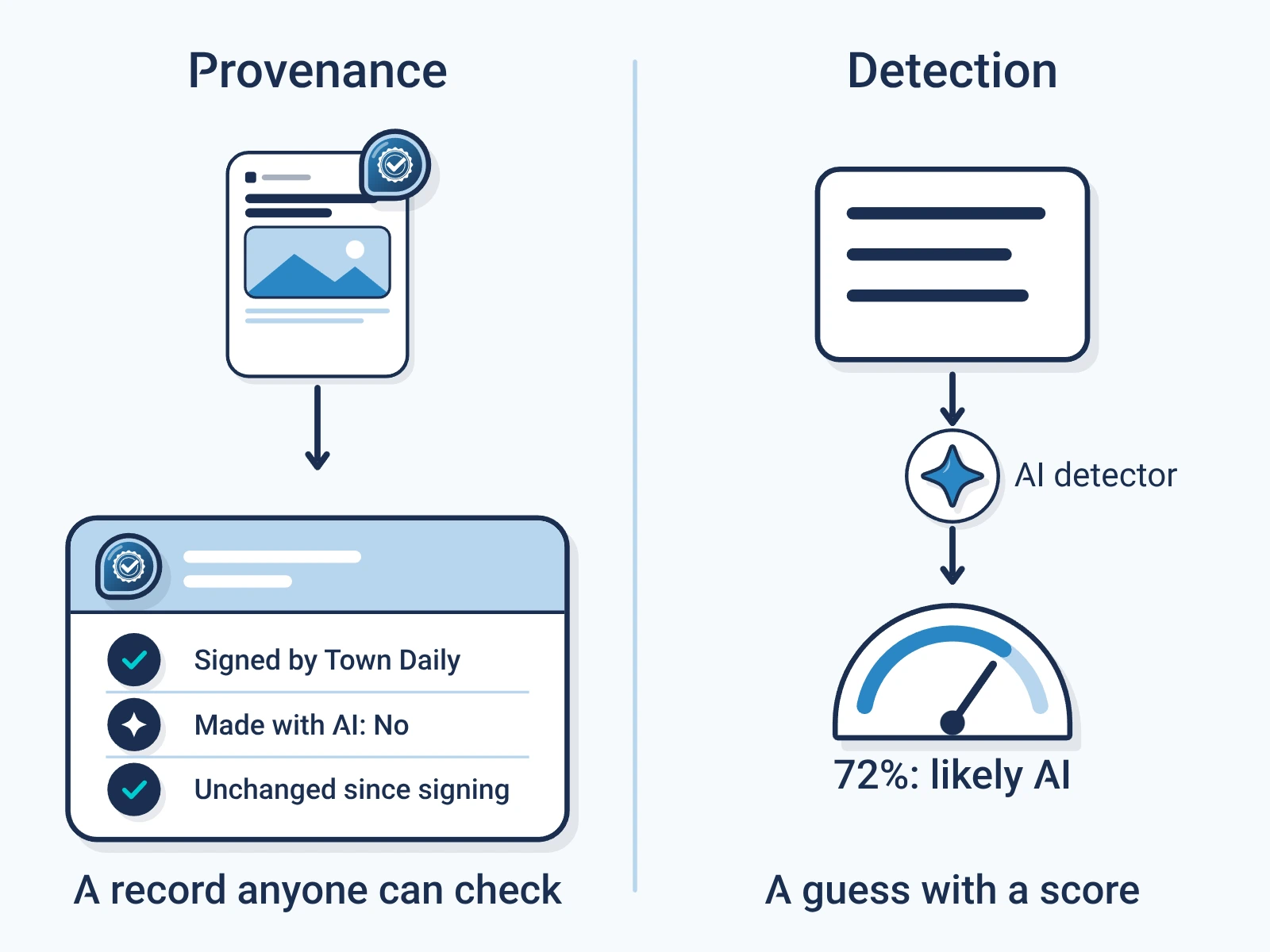
AI content detection tools guess. Content provenance proves. That distinction determines what you can do with the result.
What Detection Tools Actually Do
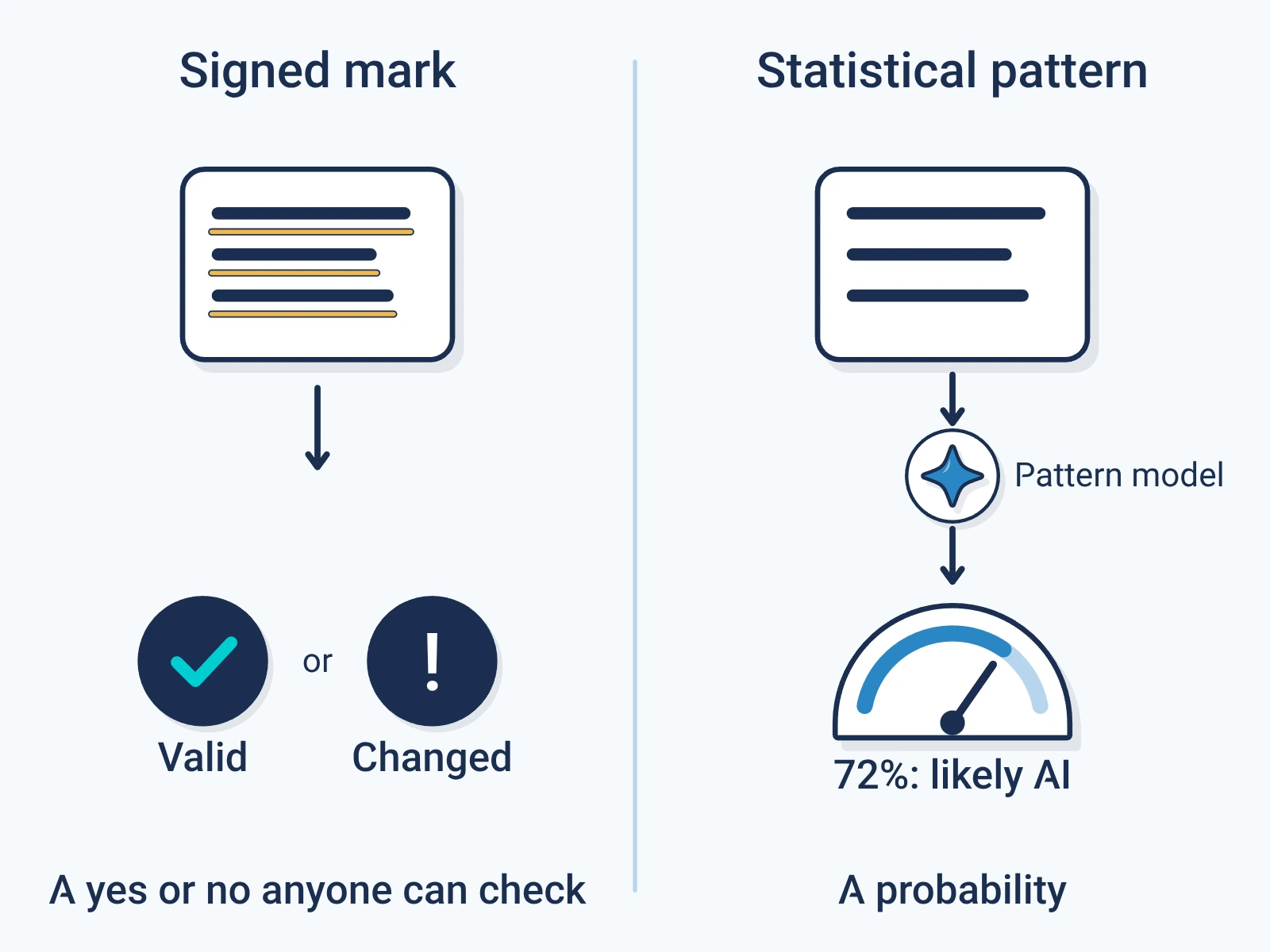
AI content detection tools - Turnitin, GPTZero, Copyleaks, and similar products - analyze text for statistical patterns that correlate with AI generation. They look at token probability distributions, sentence entropy, perplexity scores, and burstiness metrics. These patterns differ between human-written and AI-generated text in measurable but imperfect ways.
The result is a probability estimate: "this text is 73% likely to be AI-generated." That estimate is not proof. It is a statistical inference from surface features. The same features that indicate AI generation can appear in human writing - technical documentation, formal legal text, and ESL writing frequently trigger false positives. Academic studies have documented false positive rates above 50% on certain types of human-authored text.
Detection tools also fail in the inverse direction. AI-generated content that has been paraphrased, translated, or lightly edited often falls below detection thresholds. A sufficiently diverse prompt strategy can produce AI text that registers as human-authored on most detection tools.
What Content Provenance Actually Does
Content provenance embeds a cryptographic signature into the content at the moment of creation. The signature is computed from the content itself using the creator's private key. Verification uses the corresponding public key to confirm that the content matches the signature and was signed by the claimed party.
This is not statistical. Either the signature verifies or it does not. Either the content hash matches the signed hash or it does not. Either the certificate chain leads to a trusted authority or it does not. There are no probabilities. There are no confidence intervals. There are no false positives.
Provenance also answers a different question than detection. Detection asks: "Is this content AI-generated?" Provenance asks: "Who created this content, when, and has it been modified?" Those are different questions, and the second one is the question that matters for publishing, licensing, and legal proceedings.
The Accuracy Comparison
| Property | Detection Tools | Content Provenance |
|---|---|---|
| Method | Statistical pattern matching | Cryptographic signature verification |
| Output | Probability estimate (e.g., 73% AI) | Binary: verified or not verified |
| False positives | Documented in academic studies; higher on formal/technical text | Zero (cryptographic certainty) |
| Evasion | Paraphrasing and style transfer lower detection rates | Signature breaks if content is modified; evasion is detectable |
| Requires provenance | No (analyzes existing content) | Yes (content must be signed at creation) |
| Legal admissibility | Limited; statistical estimates face expert challenges | Strong; cryptographic proofs are standard evidence |
| Attribution granularity | Document-level at best | Sentence-level (Encypher proprietary) |
The Legal Distinction
In litigation, statistical estimates are vulnerable to expert witness challenge. An AI company's expert can testify that the detection tool's methodology is flawed, that the training data was biased, or that the confidence interval is too wide to support the claimed conclusion. These challenges are legitimate and courts have accepted them.
Cryptographic proof is a different category of evidence. A valid digital signature is not a statistical estimate - it is a mathematical fact. Challenging it requires demonstrating that the cryptographic system was broken, that the private key was compromised, or that the signed content was forged. Those are much harder arguments to sustain.
For publishers pursuing copyright claims, this distinction is decisive. A detection tool result says "this is probably AI-generated." A provenance verification says "this content was signed by this publisher on this date and has not been modified." The second statement is evidence. The first is an opinion.
When Detection Tools Make Sense
Detection tools address a real problem that provenance does not: identifying AI-generated content in contexts where provenance was never embedded. An educator reviewing student submissions cannot require students to sign their work with C2PA manifests before submitting. A publisher evaluating freelance pitches cannot require provenance from every contributor.
For these use cases - screening incoming content for AI-generation when you do not control the source - detection tools provide a signal worth having, with the understanding that the signal is imperfect. They are appropriate as a screening tool, not as proof.
For use cases where you do control the source - publishing your own content, distributing your own assets, documenting your own AI-generated outputs - provenance is the right infrastructure. It provides certainty where detection can only provide probability.
The Forward-Looking Case
AI generation quality is improving. Today's detection tools were trained on today's AI outputs. As generation quality improves and AI writing becomes less statistically distinguishable from human writing, detection accuracy declines. The statistical patterns that current tools rely on are temporary artifacts of current-generation models.
Cryptographic provenance does not depend on the quality of AI generation. It does not degrade as models improve. A content signature made in 2026 is equally verifiable in 2036 regardless of what AI systems exist by then. The cryptographic standard does not become obsolete as the technology it documents evolves.
Organizations building content authentication strategies around detection tools are building on a foundation that will erode. Organizations building around cryptographic provenance are building on a foundation that does not depend on the state of AI at any particular moment.
Related Resources
Start With Proof, Not Probability
Free verification for any signed content. No account required. Signing starts at $0 for up to 1,000 documents per month.