

Content provenance vs. blockchain timestamping
A blockchain timestampBlockchain timestamping: Writing a file's hash to a public ledger to show it existed at a given time. proves a file's hashHash: A short fingerprint of exact bytes. Any change, even one character, gives a completely different hash., a short code worked out from it, existed at a given time. The record stays on the chain. A signed C2PA manifestC2PA manifest: The signed label itself: a small package inside a file that records who signed it, what they declared and how to check it. travels inside the file, so whoever has the copy can check it.
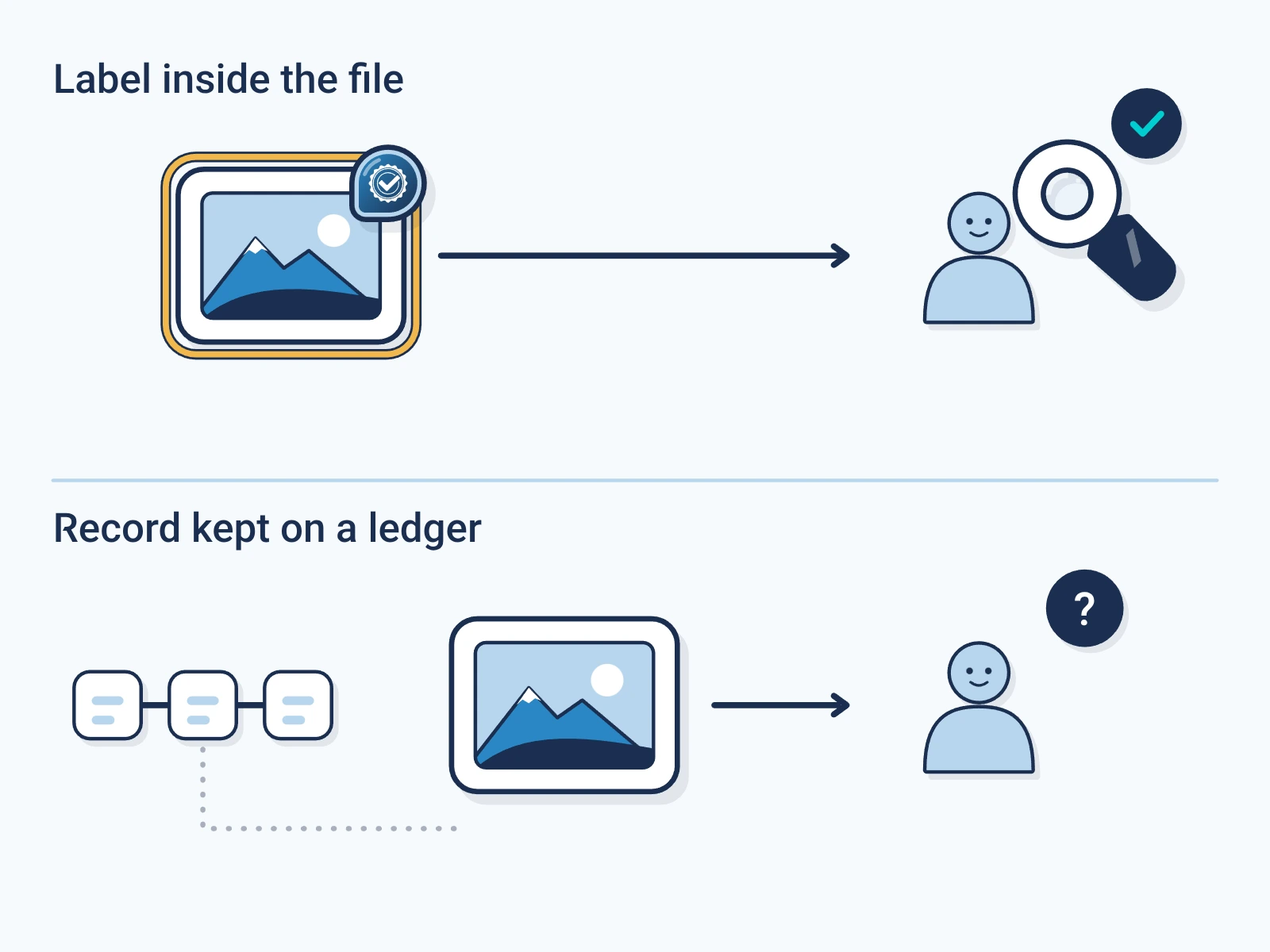
Blockchain timestamp vs. C2PA manifest
| Blockchain timestamp | C2PA manifest | |
|---|---|---|
| Where the record lives | On the chain | Inside the file or text |
| Travels with each copy | No | Yes, while the copy keeps it |
| What a check needs | The original, the chain and the transaction | The copy and a public keyPublic key cryptography: Signing with a secret private key that only the signer holds, checked by anyone with the matching public key.. Works offline. |
| Says who signed | Optional, in the transaction | Yes, a named signer |
| Carries rights terms | Rarely | Yes, machine-readable |
| Cost per record | A network fee on public chains | No fee per record |
| Public, shared ledger | Yes, its main strength | No. Trust comes from the signer's certificate. |
| How long it lasts | Durable on major chains; at risk on small ones | As long as the copy keeps the label |
| For text | One hash for the whole document | A label per document, and per sentence with Encypher |
| Signature format | Varies by chain | COSECOSE: CBOR Object Signing and Encryption: the signature format C2PA uses to sign the claim inside a label., an IETF standard, in C2PAC2PA: The Coalition for Content Provenance and Authenticity: the group that publishes the open standard for content labels. 2.4 |
When to use each
- Use a blockchain timestamp
- When you need a public, dated record that no single party controls, such as proof that an idea existed first.
- Use a C2PA manifest
- When the content will be copied, shared or syndicated, and the people who get it need to check where it came from.
- Use both
- When you want a label in the copies you send out and a public dated record of the original.
The record has to reach the copy
A story goes from the publisher to a wire service, then to hundreds of sites, then into an AI training set. A chain record stays where it was written, and nobody holding a later copy knows it exists. A provenanceContent provenance: The record of where a piece of content came from and how it changed, carried with the content itself. label inside the text makes that trip with the words.
Questions
Which is better for AI training data provenance?
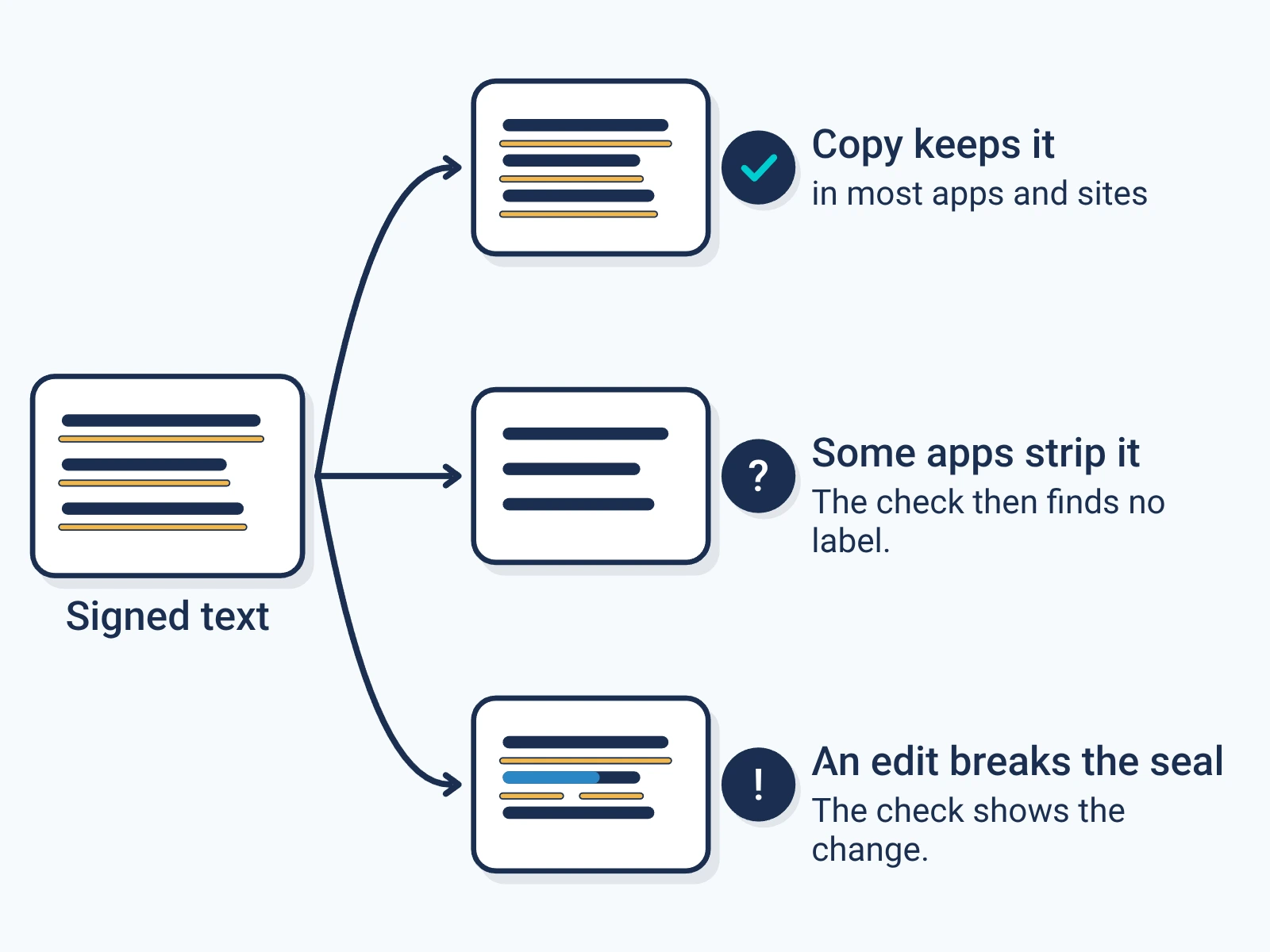
If someone strips the label, does the check notice?
Can I use both?
For engineers
Show the technical detail
- Timestamping
- A chain anchors a hash (often SHA-256) in a block; verification recomputes the hash from the original and finds the transaction. Nothing in the file references it.
- C2PA
- A COSE signature over the claim, an X.509 chain to a trust list root, and an RFC 3161 timestamp from a time stamp authority, all inside the manifest store.
- Text
- The C2PA unstructured-text method embeds the manifest as invisible Unicode characters; Encypher adds sentence-level checks.
Create. Mark. Endure.
Put the proof inside the content. Sign your first file free.