

Content provenance for publishers
On the Beeler.Tech Pub Report, Erik Svilich showed publishers how to sign their stories so buyers and AI firms can see who published them. The signed label then rides into the ad auction through PrebidPrebid: Widely used open-source code that runs the ad auction before the page loads its ads..
- Event
- Beeler.Tech
- When and where
- May 2026, Beeler.Tech publisher community
- Speakers
- Rob Beeler, the host, and Erik Svilich of Encypher.
- Length
- 17 minutes 48 seconds, with a full transcript below.
Copied work loses its name
Once a story is copied, scraped or pulled into a dataset like Common Crawl, nothing in it says who published it. A buyer cannot tell it is premium inventory. An AI firm cannot tell it is licensed work. Brands pay for brand safety for the same reason. Nobody wants an ad next to fake content from an unknown source.
How the label reaches the auction
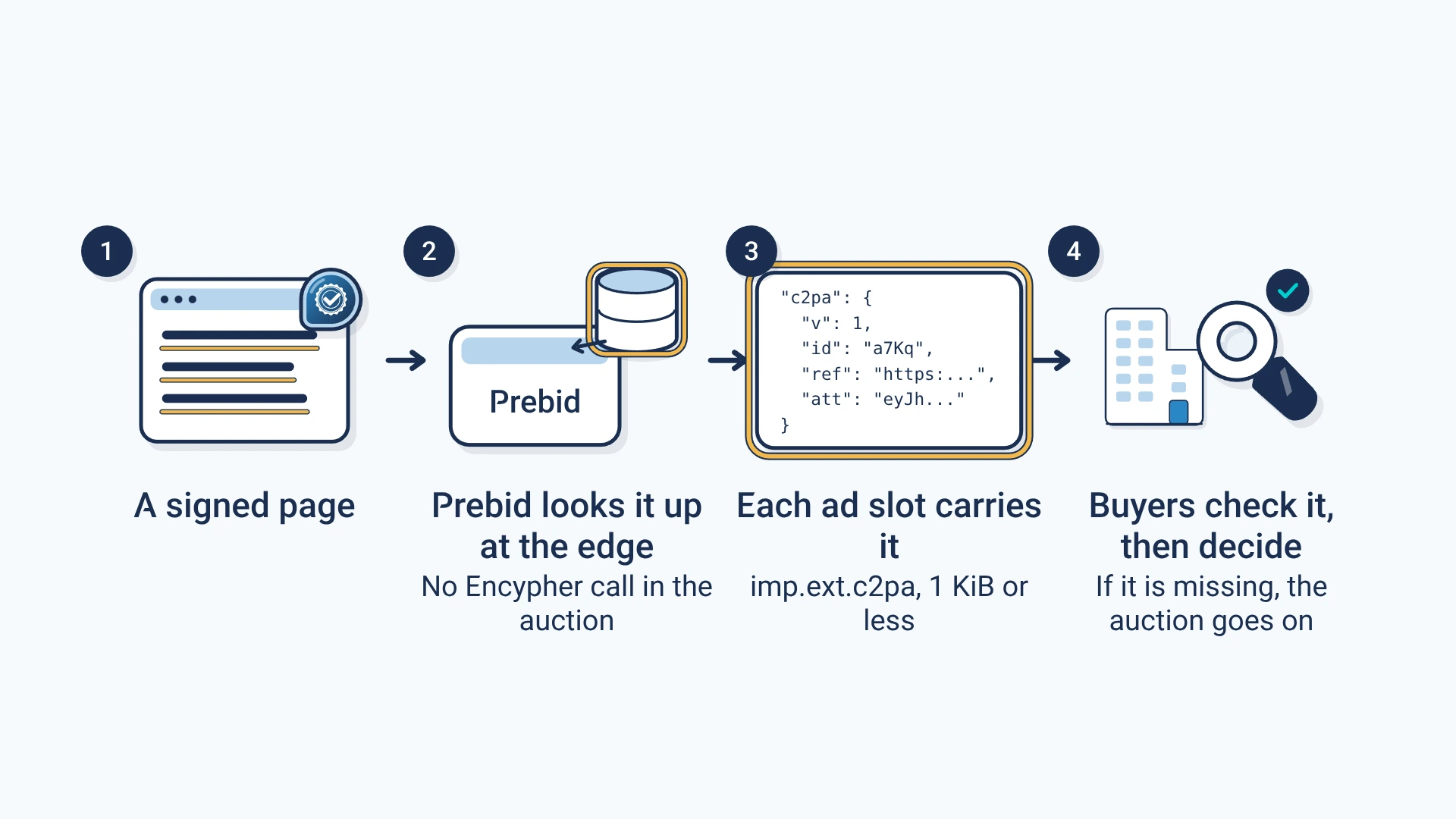
C2PAC2PA: The Coalition for Content Provenance and Authenticity: the group that publishes the open standard for content labels. is an open standard for signed labels. Erik noted it is backed by the BBC, The New York Times, Google, Meta, Microsoft, OpenAI and Adobe. You sign a story when you publish it, and the label stays with it.
Encypher's Prebid module reads the label when the page loads. It adds it to the bid request that buyers already get. It is one line in your Prebid setup, and the check is cached, so pages do not slow down.
What publishers get
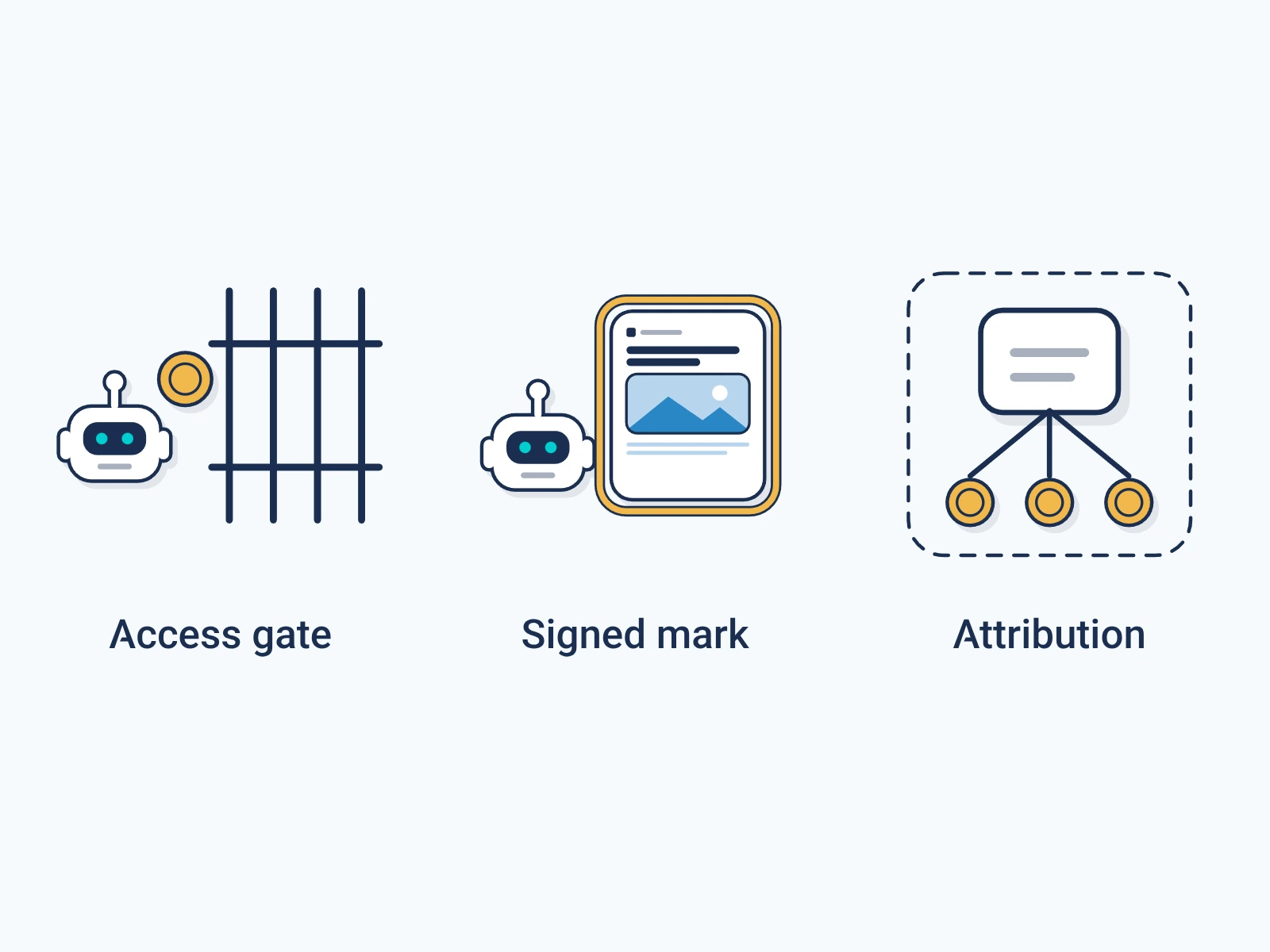
- A reason to bid more
- A signed page tells buyers which publisher it came from. Erik said the pilots are early, so a rise in price is not yet measured.
- A record for licensing
- The label carries your name and your terms inside the work. That helps when you enforce a license or a contract.
- Free signing
- Encypher signs publisher content for free, with a WordPress plugin or an APIAPI: Application programming interface: a way for one program to ask another to do a job, such as sign a file..
Why now
Brands now ask for labels on publisher sites, Erik said, and provenanceContent provenance: The record of where a piece of content came from and how it changed, carried with the content itself. is part of AdCP, a new standard for ad context. The EU AI ActEU AI Act: The European Union's law on artificial intelligence, which includes rules for marking AI-made content. rules on marking AI content apply from August 2, 2026. As Rob Beeler put it, do the work now and you are ready when the courts set the rules.
Erik wrote the C2PA standard for unstructured textC2PA text-provenance standard: The part of the C2PA standard that puts a signed label inside plain text, using invisible Unicode characters., published in January 2026.
Speakers, chapters and transcript
Show the technical detailEvery word of the recording, with chapter times.
Speakers
- Rob Beeler (Host, founder of Beeler.Tech)
- Erik Svilich (Founder and CEO of Encypher; Co-Chair, C2PA Text Provenance Task Force)
Chapters
- 0:00 Introduction
- 0:09 What C2PA is, and the brand-safety problem with AI slop
- 4:26 How provenance moves through the ad stack, and what publishers get
- 9:06 How you apply it: WordPress, CMS, and API
- 10:47 Why volume matters: network effects for publishers
- 12:02 Brand demand, IPTC, and AdCP
- 13:25 Q&A: source reputation versus continuous verification, and latency
- 16:06 Q&A: is CPM uplift measurable yet?
- 16:28 Early pilots, and who wrote the C2PA text standard
- 17:44 Closing thoughts
Transcript
This transcript was made by AI and lightly edited for readability. It may contain mistakes, including in wording and speaker labels. Two clarifications are added in brackets. The recording is the source of record.
- Rob Beeler
- Now on to Erik, who's going to talk a little about C2PA. Erik, I'll turn things over to you.
- Erik Svilich
- Thank you so much, Rob. You set it up nicely: publishers taking their own destiny into their hands. That's part of why I'm here, using content authenticity and provenance as that backbone. C2PA is an acronym, c2pa.org, it stands for the Coalition for Content Provenance and Authenticity. It's a standards organization backed by the BBC, The New York Times, Google, Meta, Microsoft, OpenAI, Adobe, and many others, focused on how we embed machine-readable cryptographic data into images, video, audio, and text. There's a huge problem right now, especially with how easily accessible AI has become. There are sites spinning up entire websites that are just made-for-advertising (MFA) junk, AI slop built to grab revenue. Brands are very concerned about brand identity and brand safety. Coca-Cola, for example, doesn't want its ad next to AI-generated, deepfaked, or politically charged content tied to some unknown source. Without a machine-readable signal that says "this is legitimate publisher content," buyers can't separate your content from scraped archival content or low-value AI slop. Today there's really no source signal. If your content gets copied, pasted, scraped, or pulled into Common Crawl, it no longer links back to you. C2PA fundamentally changes this. It's a machine-readable way to embed license and rights information plus organizational identity, down to the individual journalist if you want. So when content is copied, pasted, scraped, or lands in another database, the proof that it came from your organization travels with the content itself. That changes the legal landscape between media companies and AI companies, where there are dozens of lawsuits right now. So there are two things: proving content is legitimate and proving it came from you, then using that proof to support licensing and the ad tech ecosystem.
- Erik Svilich
- So how does this provenance signal enter the midstream? The first step is to sign your content. Typically content is signed when it's created or when you hit publish, and the signal is embedded into the content itself, so it follows the content as it moves. This works for text, images, video, and audio across your pages and archives. The next step, for the ad tech audience, is detecting the signal using something like Prebid header bidding. We built a Real-Time Data (RTD) module that reads these signals and injects provenance into the midstream. Prebid reads the provenance signal on page load, with a caching layer, so there's very little lift for publishers. It's a one-line config in your Prebid setup. That signal then travels to SSPs and DSPs: verification is passed in the bid request, and every buyer can see it in the auction. On the revenue side, buyers can bid on authentic inventory, which is the basis for a potential CPM uplift, or at the very least premium ad dollars coming to you over someone else. The other side of detection: if your content is copied into Common Crawl or into an AI system, we're working on verifying that your content has entered that system, and on attaching the licensing rights so you get analytics and get paid based on the C2PA signal. C2PA is an open standard, anyone can implement it for free. OpenAI and Google already support C2PA in their AI outputs, and they're working on reading the signal natively on ingest. So what do publishers get? CPM uplift and a differentiation signal: authenticated inventory gives buyers a reason to bid toward verified content. It's also a machine-readable quality signal, proof it came from a real publisher, which makes it good data to train on. You also get much stronger leverage in a court of law: you have machine-readable rights embedded in the content itself, cryptographically bound to your organization so it can't be spoofed. We offer free signing for publishers using C2PA-based technology and watermarking. You keep the licensing revenue, and we take a fee as the independent third-party verification layer that makes sure you get paid and your license is respected.
- Rob Beeler
- Appreciate it, Erik. There's integration at the front end. You said something gets "stamped," correct me on terminology, when my editorial team hits publish. Is that a WordPress plugin? A script? How does it get applied?
- Erik Svilich
- Great question. We have a WordPress plugin that signs images, video, audio, and text. Whenever you hit post or update, it signs automatically, and you can bulk-sign your archives. For WordPress users it should be fairly plug-and-play. For other CMS or headless CMS systems, we've written integrations on an ad hoc basis or in partnership with the platforms publishers increasingly use. "Stamping" is a good analogy, it's like a notary stamp. It can be a script, it's an API, so anyone can integrate it into any platform, but the WordPress plugin is fairly turnkey.
- Rob Beeler
- You mentioned some large companies are behind this. One thing that would be amazing to do as a community is to start tracking this: if we get volume, that signal becomes something SSPs and DSPs start to look for. It changes the conversation around MFA. There's a buildup here that could be really powerful.
- Erik Svilich
- Two important points. The more people who do this, the more value there is for publishers. The more publishers can assert "this is my legitimate content," and work with groups like RSL (Really Simple Licensing) on group licensing, the better terms and analytics everyone gets.
- Erik Svilich
- We're part of about a dozen standards organizations, and IPTC is one of them. Someone from the 4A's (American Association of Advertising Agencies) presented at the IPTC Spring Summit about a month ago, and they have said they want C2PA on websites by the end of the year if possible, because brands are so concerned that they have increased brand-safety budgets and are willing to require this signal to survive through the ecosystem. We've worked with Prebid on the Prebid module, and provenance is now officially part of AdCP (Ad Context Protocol) in the newest spec. We've been talking with the IAB, and we'll work with anyone who wants to be interoperable with this standard. This is coming from the brands' mouths. The more publishers provide authentic, verified inventory, the more dollars go to legitimate publishers, and hopefully the higher CPMs we can command.
- Rob Beeler
- Brian has a couple of questions. Is the intent to confer reputation to the source domain, or are downstream participants expected to continuously verify content? And if it's the latter, what's the latency cost for signature verification?
- Erik Svilich
- Good technical questions. There are different levels of what you can assert and what identity you can assert: website level, even individual reporter level, and per asset on the page. Say you bought an image from Getty Images: you don't own the rights to it, but maybe you wrote the article, and maybe you also quoted a politician. You can't claim rights over the quote, and someone else owns the image. So you need to embed that granularly into your content, which is what we do. When the content moves across the internet, those markers survive. [Clarification: today, platforms such as LinkedIn, Instagram, and TikTok read and display Content Credentials to label content, but most still strip the C2PA manifest when they re-encode an upload. Durable preservation through re-encoding is the next frontier, which is why Encypher pairs C2PA metadata with watermarking so the signal survives.] On latency: verification is free and fairly low. We have a free Chrome plugin that doesn't even need an account, you visit a page and it tells you if there are signals on it. There's also caching in the Prebid server, so you're not verifying on every page load, it runs once and caches for a period. And C2PA verification is being integrated into Chrome. [Clarification: at Google I/O 2026, Google confirmed C2PA verification is coming to Google Search and Chrome in the coming months, and is already live in the Gemini app.]
- Rob Beeler
- Last question: CPM uplift. Is it too early to measure? Do you have anything to report?
- Erik Svilich
- We're in the early stage of proving the market on CPM, which is why I said "might." If I had a hard percentage, I'd have shown it. We're working on making sure the signal is survivable through the entire ad tech ecosystem, which is why we're working with Prebid, AdCP, and the IAB. But content has to be marked for any of that to happen, and there are several reasons to mark it anyway, including CPM uplift. We're in early pilot, so I don't have enough numbers to state a figure publicly with confidence. By the way, I wrote the C2PA standard for text and co-chair the Text Task Force; that was published in January this year. So this is very new. The more people who sign, the faster we can prove it out. If you're interested, please contact me.
- Rob Beeler
- As we transition: the CPM question is spot on, and this is also a bigger thing. I don't see a future where publishers aren't having to license and defend their content and intellectual property, and I love that you framed it as IP, not just "content." Doing the work now means that when precedent is set, you'll already have done it. This is an immediate signal to my editorial team that we're protecting ourselves, and being able to pass that signal on helps us push the buy side: why spend on tools to detect whether I'm real when here it is? Great stuff.
Create. Mark. Endure.
Sign a sample story and see the label a buyer would read.