

AI provenance laws and what each one asks.
The EU and California now require labels on AI content. Here is who each rule binds, what it asks, and where a signed label helps.
Last reviewed October 2, 2026. Technical information, not legal advice.
Two laws, one clock
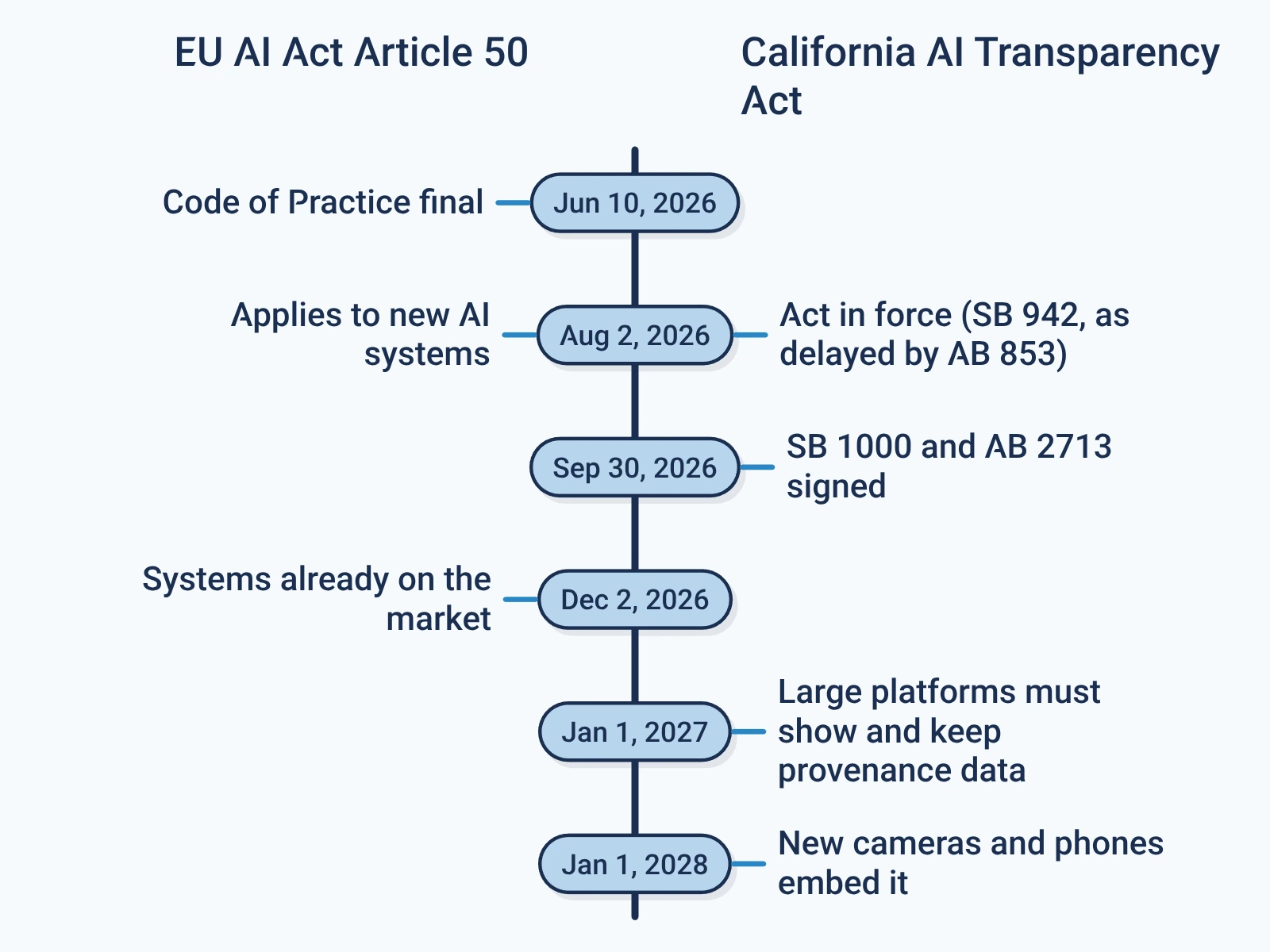
Article 50Article 50: The EU AI Act rule that AI-made content be marked in a form software can read, and deepfakes disclosed. of the EU AI ActEU AI Act: The European Union's law on artificial intelligence, which includes rules for marking AI-made content. has applied since August 2, 2026. AI tools already on sale before then have until December 2, 2026 to add Article 50(2) marking. Every other duty applied from August 2, 2026. The California AI Transparency ActCalifornia AI Transparency Act: California's law requiring generative AI providers to hide an AI disclosure in the images, video and audio they make or edit, and offer a free tool that reads it. has applied since August 2, 2026. It was amended on September 30, 2026. Platform duties start on January 1, 2027.
Both laws ask for content provenanceContent provenance: The record of where a piece of content came from and how it changed, carried with the content itself.: a record of where content came from that software can read.
The register
A duty to disclose and a duty to carry a label are different rules. Each row says who is bound and what a signed label can do.
| Status | Who it binds | What it asks | Where a label fits | |
|---|---|---|---|---|
| EU AI Act Article 50 | In force | Each AI providerProvider: Under the EU AI Act, the company that builds an AI system or puts it on the EU market under its own name. and deployerDeployer: Under the EU AI Act, a company that uses an AI system in its own work, such as a newsroom publishing AI-edited text. serving the EU, wherever it is based. | Machine-readable markingMachine-readable marking: A label software can read that says content was made or changed by AI. of AI output. A visible notice for each deepfakeDeepfake: Image, audio or video made or changed by AI so it looks real and could fool people. and some public-interest text. | A signed C2PA manifestC2PA manifest: The signed label itself: a small package inside a file that records who signed it, what they declared and how to check it. is one standard layer. Text needs a mark inside the words. |
| California AI Transparency Act | In force, amended | Every public AI provider in California. Large platforms from 2027. Device makers from 2028. | A hidden latent disclosureLatent disclosure: Under California law, a hidden label inside a file that says which AI system made or changed it and when. in AI images, video, and audio, plus a free checking tool. Platforms must keep and show labels. | A C2PAC2PA: The Coalition for Content Provenance and Authenticity: the group that publishes the open standard for content labels. label can hold the fields. Making it hard to remove, and the tool, are separate duties. |
| United States, federal | No general mandate | No federal law makes every AI output carry a label. | Rules for some fields, for ads and elections, and contracts can still apply. | A label shows where work came from and what was said about AI. It is not a safe harbor. |
| Other US states | Varies | Many states have rules on fakes in elections, of real people, or of private images. | Often a visible notice or a takedown process, not a hidden label. | A label can support a disclosure program. Map each law on its own. |
Get the next change by email
Get AI law updates by email
One email when a law changes. Nothing else.
Policy questions? Write to us.
Good questions.
Is there a US federal law that requires AI labels?
Does any law require C2PA?
Is this legal advice?
Create. Mark. Endure.
Mark one AI output free and see what the label records.