

Check your Article 50 duties and output-marking gaps.
Answer a few questions about the AI you build or use. You see each likely Article 50Article 50: The EU AI Act rule that AI-made content be marked in a form software can read, and deepfakes disclosed. duty on its own, and you get a one-page report. It takes about two minutes, with no account.
In force since August 2, 2026. Existing-system transition: December 2, 2026. It covers only eligible Article 50(2) provider systems already on the market. It does not defer deployer duties.
Your readiness check
Which best describes what your organization does with AI for content?
Provider duties and deployer duties are different. Article 50(1) and 50(2) fall on providers; Article 50(3) and 50(4) fall on deployers.
What the law asks, and when
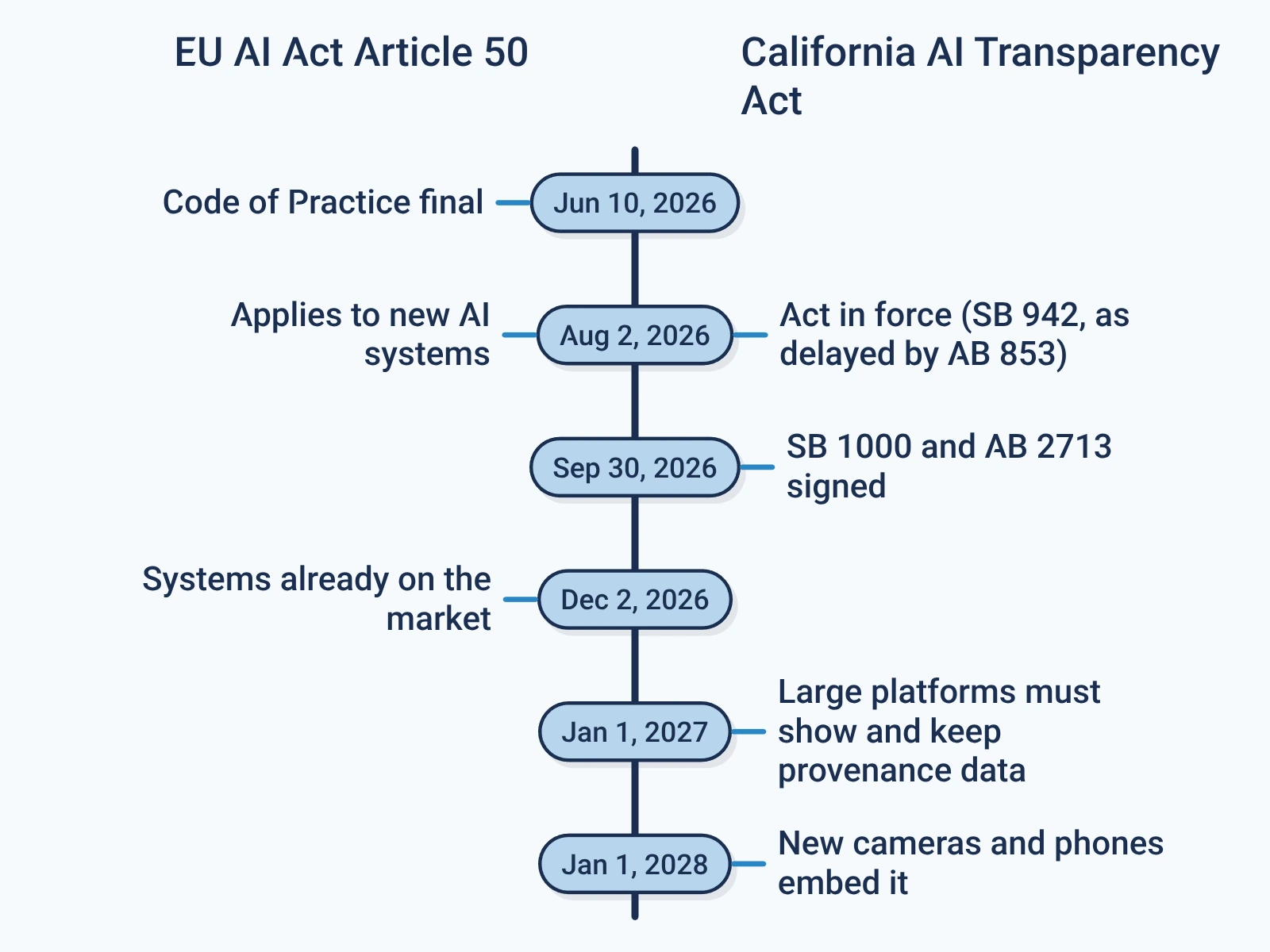
The EU AI ActEU AI Act: The European Union's law on artificial intelligence, which includes rules for marking AI-made content. splits the work. Providers must mark what their AI makes so that software can read it. An AI deployerDeployer: Under the EU AI Act, a company that uses an AI system in its own work, such as a newsroom publishing AI-edited text. must say when it shows a deepfakeDeepfake: Image, audio or video made or changed by AI so it looks real and could fool people.. It must also say so for AI text published to inform the public on matters of public interest.
The check follows Article 50. Non-compliance carries fines of up to EUR 15 million or 3 percent of global annual turnover. That is the Article 99(4) cap, whichever amount is higher; for small and medium firms, start-ups, and small mid-caps, the lower amount applies. The check also uses the final Code of PracticeCode of Practice on AI-generated content: The EU's voluntary rulebook on marking and labeling AI content, published in final form on June 10, 2026. on AI content, published June 10, 2026. The Code is voluntary. It does not replace the law. This tool is not legal advice.
California has its own law, the California AI Transparency ActCalifornia AI Transparency Act: California's law requiring generative AI providers to hide an AI disclosure in the images, video and audio they make or edit, and offer a free tool that reads it.. Two bills became law on September 30, 2026: SB 1000 (Chapter 861) and AB 2713 (Chapter 856). SB 1000 took effect that day. The law now covers each public AI tool, no matter how few users it has. This check covers only the EU rules.
For AI agents and machine clients
Show the technical detailThe same check is a free JSON API with no sign-in.
Fetch the endpoint with no parameters to get a specification of every parameter and allowed value. A parameterized URL returns a quick readiness score, each Article 50 duty with its status, and prioritized actions. It takes fewer inputs than the check above, so for a full answer use the check.
# Self-describing specification
GET https://encypher.com/api/tools/eu-ai-act-readiness
# A quick score from fewer inputs than the on-page check
GET https://encypher.com/api/tools/eu-ai-act-readiness?role=deployer&euNexus=yes&exposurePaths=generate&contentTypes=text&disclosure=visible&evidence=partial&status=planning