Encypher Logo

Rights management

Machine-readable terms, machine-made verdicts.

Anyone can publish a rights file. Encypher built the part that decides: a deterministic W3C ODRL 2.2 policy engine that takes your terms plus an intended use and answers permit or prohibit, the same way every time. Every document you sign with C2PA carries its own ODRL policy, bound at signing and resolvable from the manifest, on top of the same content provenance infrastructure.

W3C ODRL 2.2

policy projection on every signed document

odrl-engine/0.1.0

deterministic, fail-closed, dependency-free

C2PA 2.4

manifest, rights snapshot, and policy under one document id

The engine

We built the part that decides

W3C ODRL is a language for writing rights policies, and a language does not answer questions. The Encypher engine takes a policy and a concrete intended use and returns a verdict, with the rules that matched and the reason it reached them.

A rights answer that changes between two identical questions is worth nothing to whoever relies on it. So the engine is built to be boring: same policy, same question, same verdict, and every path it cannot resolve with certainty resolves to no.

Deterministic
The same policy and the same intended use return the same verdict every time. Each response carries the engine version, odrl-engine/0.1.0, plus SHA-256 hashes of the policy and the request, so a decision taken months ago can be reproduced exactly.
Fail-closed
Ambiguous, malformed, unsupported, or over-limit input denies rather than grants. An incomparable constraint, an unknown operator, a non-scalar operand, a policy nested past the safety budget: each one resolves to no, never to yes.
Prohibition wins
When a permission and a prohibition both match the same action, the prohibition takes the decision. A policy that names an unrecognized conflict strategy also resolves to prohibit.
Defaults to deny
No matching rule means no signal, and no signal means no. A caller can ask for a permissive default explicitly, but a structurally malformed policy never grants even then.
Dependency-free
Pure evaluation. No network call, no document lookup, no third-party rules library. The same code path runs inside Encypher verification and inside your own stack.

Where it runs

POST/public/rights/odrl/evaluate

Public evaluation, no key required

Send any W3C ODRL policy plus an intended action and constraint context. Pure evaluation: no document lookup, no account, rate limited per IP. Point it at your own policies before you integrate anything.

GET/public/rights/{document_id}/odrl

A policy per document, bound at signing

Every signed document gets its own W3C ODRL policy, resolved when the document is signed from your profile plus any document-level override. The C2PA 2.4 manifest, the rights snapshot, and the policy all resolve under the same document id.

POST/verify/advanced?intended_use=

Clearance on verification

Authenticated verification can carry an intended use: ai_training, ai_inference, data_mining, scraping, or rag_retrieval. Encypher projects the publisher policy to ODRL, runs the same engine server-side, and returns the clearance next to the verification result.

The verdict

Five decisions, one usable answer

The engine is explicit about why it decided what it decided. Every response names the matched rules, the reason, and any duties attached to a permission.

  • permittedUsable: Yes

    A permission matched the action and every constraint on it held.

  • permitted_with_dutiesUsable: Yes

    A permission matched and carries obligations, such as attribution or payment. The duties come back named.

  • prohibitedUsable: No

    A prohibition matched the action, or a permission and a prohibition collided and the prohibition won.

  • no_matching_ruleUsable: No, by default

    Nothing in the policy speaks to this action. Absent an explicit permissive default, the engine denies.

  • invalidUsable: No

    The policy could not be evaluated safely, or the policy itself asked for a permission/prohibition collision to be reported as invalid.

Permit, prohibit, license-required. Verify a document with an intended use and the five decisions collapse to one clearance answer: permit or prohibit. License-required is not an ODRL decision. It is a pricing outcome layered on a permit: the policy allows the use and the publisher expects payment for it, so the response carries the pricing terms and the licensing contact alongside the permit.
The verdict is advisory. Encypher reports what a policy says about a use. It does not sit inside a retrieval or training path, and it never grants permission on behalf of a publisher. The answer is deterministic and machine-readable precisely so your own systems, and the systems on the other side of the deal, can act on it.

Verified clearance

A policy verdict becomes a durable answer

The authenticated clearance path keeps provenance, the ODRL decision, license acquisition, and the Encypher verification receipt separate. A single cleared label never hides which fact changed.

  1. 1

    Inventory

    Every successful production sign becomes one durable inventory generation before the API or background job reports success. Current and historical generations keep their provenance, status, and immutable rights evidence distinct.

  2. 2

    Decision

    A clearance check resolves one signed generation and one intended use through the same fail-closed ODRL engine. Provenance and the policy decision remain separate facts.

  3. 3

    Acquisition

    If the policy permits the use only with license duties, Encypher checks for an exact, effective agreement accepted by both parties. A merely compatible or pending deal does not clear.

  4. 4

    Receipt

    When verification is required, Encypher rechecks provenance, rights, agreement, status, and trust before issuing a signed, timestamped clearance receipt. Public verification accepts caller-supplied receipt bytes; receipt ids are not enumerable.

Production buyers call POST /api/v1/rights-clearance/check with public signed evidence and one intended use. Publishers can preview their own inventory without issuing a receipt. A prohibited result never offers a license action, and a license-required result remains uncleared until the exact agreement is effective.

The tiers

Three tiers, three use cases

Bronze, Silver, and Gold are what the ODRL policy encodes. Set them once and every signed document projects the same permissions, prohibitions, and duties, aligned to how AI companies actually use content.

Bronze

Crawling and scraping

Controls broad read-only access: search indexing, price comparisons, web archiving, and general AI data collection.

  • Web crawlers (Googlebot, GPTBot)
  • Training data collection
  • RSS / feed aggregation
  • robots.txt-aligned signals

Silver

RAG and retrieval

Controls AI-powered search and retrieval-augmented generation pipelines: the largest current use case.

  • RAG grounding data
  • Real-time AI search
  • Perplexity, SearchGPT, Bing AI
  • Enterprise AI assistants
Highest value

Gold

Training and fine-tuning

Controls use of your content for AI model training and fine-tuning, the highest-value licensing category.

  • LLM pre-training datasets
  • Fine-tuning and RLHF
  • Model evaluation benchmarks
  • Synthetic data generation

How it works

From first signed document to a policy machines can evaluate

Five steps from your first signed document to a W3C ODRL policy any AI company can resolve, evaluate, and cite.

  1. 1

    Sign

    Publish content with Encypher. Every document gets a C2PA 2.4-compliant signature with your rights_resolution_url embedded in the manifest.

  2. 2

    Publish your profile

    Set your Bronze / Silver / Gold terms once. They apply to all signed content automatically.

  3. 3

    Encypher projects the policy

    At signing time your terms become a W3C ODRL 2.2 policy for that specific document, published at a stable URL and reachable from the manifest. RSL 1.0 XML is available from the same registry for tools that expect it.

  4. 4

    The engine returns a verdict

    An AI company sends the policy and its intended use to the ODRL engine and gets back a deterministic, machine-readable verdict, with the matched rules, the reason, and any duties attached.

  5. 5

    License or notice

    As AI companies adopt provenance checking, compliant ones license through the coalition. Non-compliant use is documented to support a formal infringement notice.

Compatibility

RSL 1.0 compatible

RSL is a way to publish terms, and publishing terms is the easy half. Encypher speaks it so your terms land wherever RSL-aware tools look, and leaves the deciding to ODRL.

What Encypher supports

  • RSL 1.0 XML at /public/rights/organization/{id}/rsl
  • Import an existing RSL document as your rights profile
  • robots.txt additions and rights-discovery meta tags
  • Advisory OLP token handshake for crawlers that ask for one

Where the compatibility ends

  • No RSL evaluation engine: every decision runs on W3C ODRL
  • No RSL schema validation, on emit or on import
  • An OLP token is an advisory handshake, never a permission grant

That is the honest ceiling, and it is deliberate. Two formats to publish in, one engine to decide with.

Enforcement

Strengthen the case for willful infringement

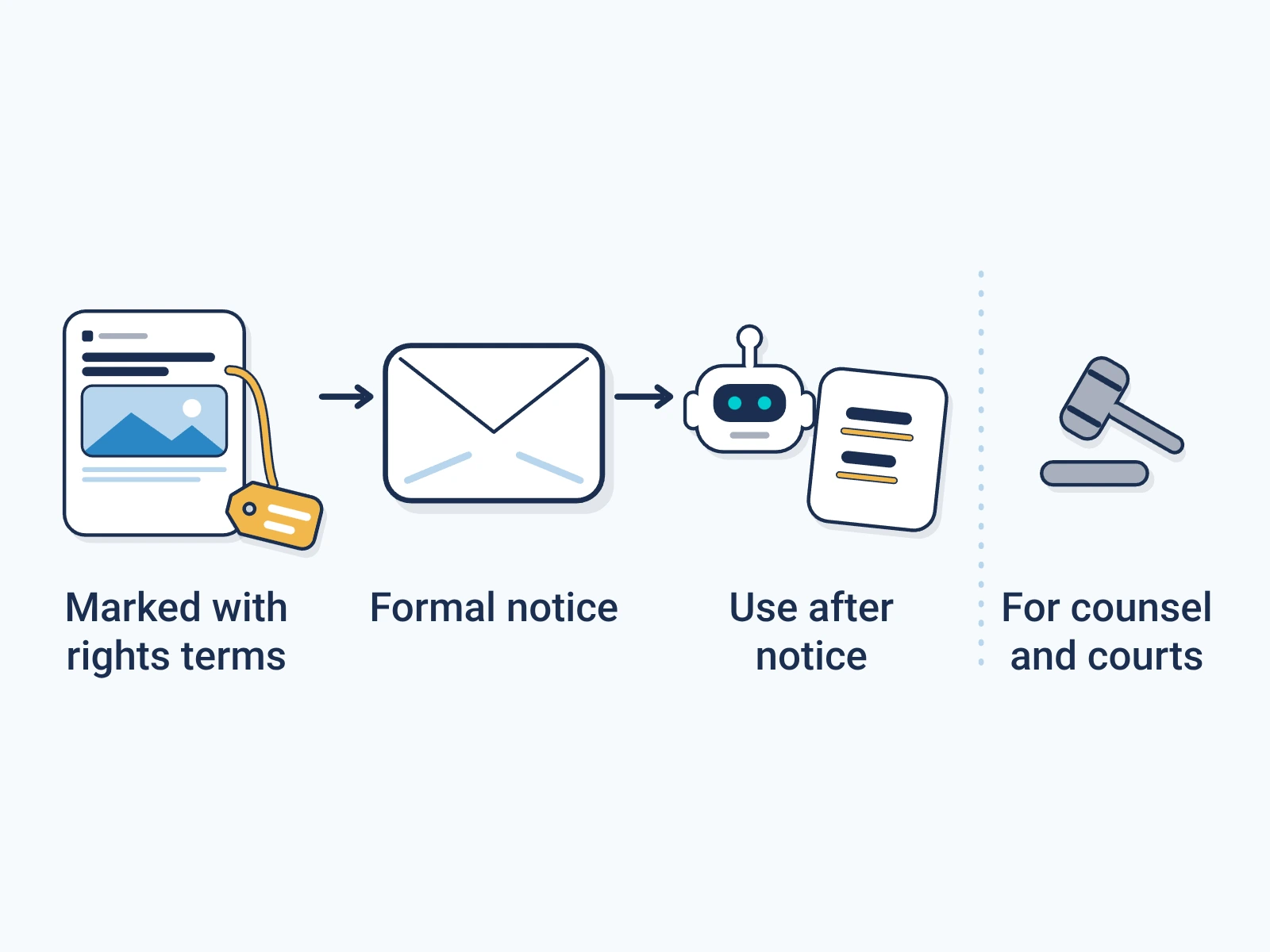
AI companies can no longer claim ignorance. When your rights profile is embedded in every signed document, using your content without a license is knowingly ignoring machine-readable terms.

You can issue notice at any time; Encypher's notice package (coming soon) assembles the evidence record: a tamper-evident record of when you published the content and that your machine-readable terms were available.

  • Immutable notice with tamper-evident evidence chain
  • Delivery confirmation and timestamped proof of receipt
  • Documentation of marked content in their pipeline
  • Chain-of-custody from signing through detection

The evidence package (coming soon) will assemble a complete litigation-support record for any infringement claim. Merkle proofs establish sentence-level provenance from the moment of signing, and every event in the chain is cryptographically linked and independently verifiable.

Formal Notice Package

Coming soon

Issued to a specific AI company. Contact sales to discuss early access.

  • Cryptographically-backed notice letter
  • Verification API access instructions for recipient
  • Evidence of marked content in training pipeline
  • Tamper-evident delivery receipt

Evidence Package

Coming soon

Complete litigation-support package for any infringement claim. Contact sales to discuss early access.

  • Merkle tree proofs: sentence-level provenance
  • Chain-of-custody documentation
  • Tamper-evident manifest records
  • Formal notice delivery records
  • Timeline reconstruction
  • Cryptographic verification instructions for counsel
  • Export in standard litigation support formats

Pricing

Simple, transparent pricing

Free signing infrastructure. Enforcement tools are priced through a sales conversation.

FeaturePrice
Document signing (C2PA 2.4)Free (unlimited, fair use)
Rights profile (Bronze / Silver / Gold)Free
Public rights resolution URLFree
Coalition enrollment (opt-in) & content indexingFree
Attribution Analytics dashboardContact sales
Formal Notice PackageComing soon
Evidence PackageComing soon
Enforcement Bundle (all enforcement tools)Coming soon
Revenue model: You keep 100% of your licensing revenue; AI companies pay Encypher a separate verification fee. Coalition membership is opt-in via a separate agreement, and Encypher-brokered coalition deals share a portion with Encypher, with exact terms in your coalition agreement. Learn about the Coalition.

For AI companies

One integration, the entire ecosystem

Resolve one policy format, call one evaluation endpoint, and get a verdict you can log. That covers every Encypher-signed publisher, so you build the provenance and rights path once.

W3C ODRL clearance API

POST /public/rights/odrl/evaluate takes a policy and an intended use and returns a deterministic verdict with its reasoning. No key, no document lookup, nothing to integrate before you try it.

A policy per document

GET /public/rights/{document_id}/odrl returns the W3C ODRL policy bound to that document at signing. Resolve it from the manifest, evaluate it, log the verdict.

Quote Integrity API

Verify AI attribution accuracy before publishing. Prove whether a cited quote is accurate, approximate, or hallucinated.

Coalition licensing

Single agreement covers all coalition publishers. Structured licensing at scale, not 1:1 negotiations.

FAQ

Frequently asked questions

Common questions from publishers evaluating rights management for their content.

Ready to take control?

Set up your rights profile in minutes. Free to start. Enforcement tools available when you need them.

Set up your rights profile