

One verification API for every output. One API. Separate evidence.
Send text, an image, audio, video or a document. You get one result that lists each check on its own, so your code decides what to trust.
One vendor. One integration. Every output type.
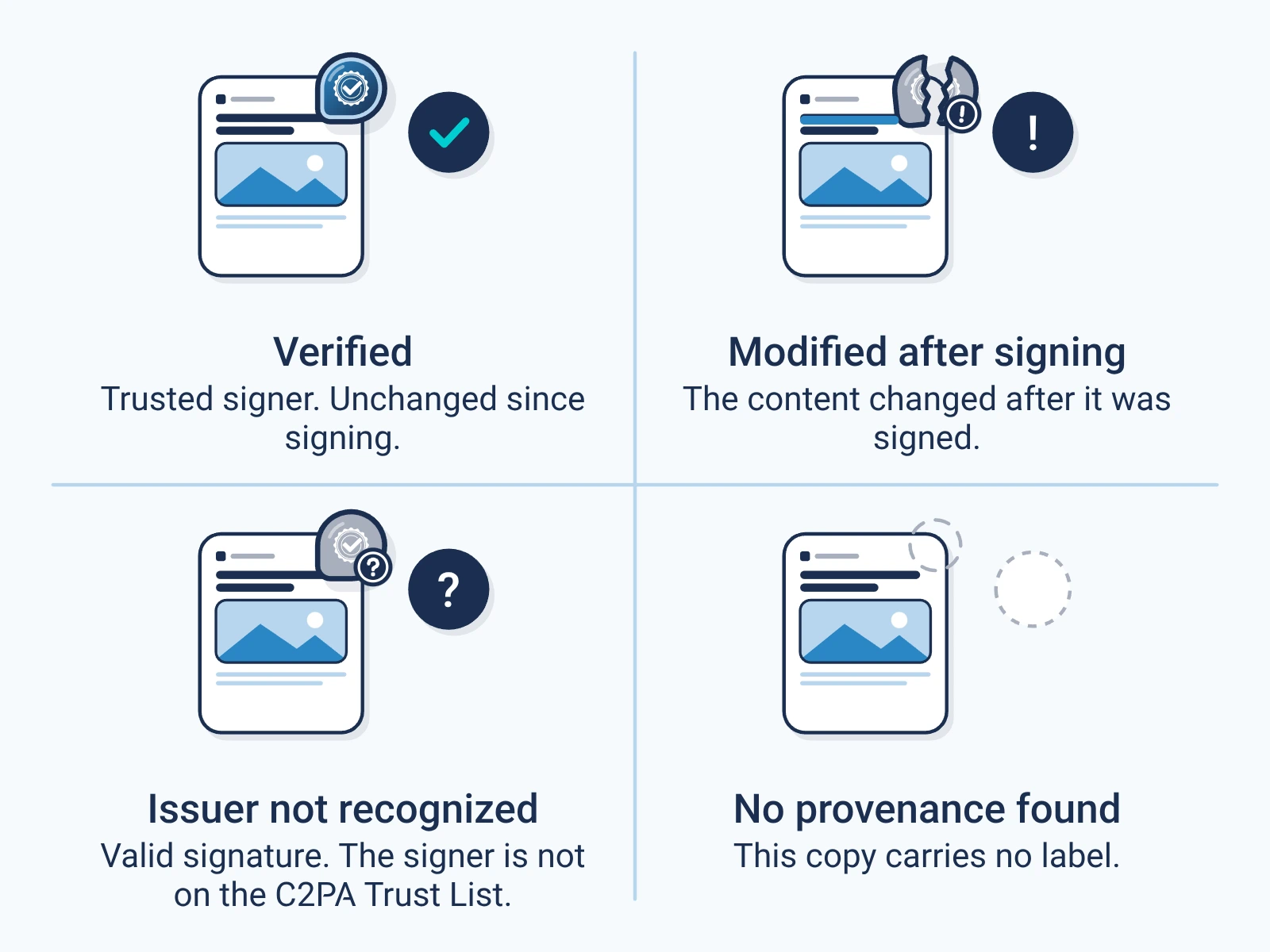
- One contract
- Text and files go to matching endpoints of one APIAPI: Application programming interface: a way for one program to ask another to do a job, such as sign a file.. Each runs the checks that fit.
- Separate evidence
- The label, a watermark and a recovered record each get their own status. Nothing is merged into one score.
- Any signer
- It reads C2PAC2PA: The Coalition for Content Provenance and Authenticity: the group that publishes the open standard for content labels. labels from any signer, not just ours.
- Free to start
- The basic public check is free. It needs no account and no API keyAPI key: A secret string that identifies your account when your software calls an API. Keep it out of public code..
What you get back
Each kind of evidence keeps its own status. A signature is proof. A watermark is a signal.
| Evidence | Status | What the result keeps |
|---|---|---|
| C2PA credential | Present, absent or invalid | Signer, timestamp, claim and hard-binding evidence |
| Watermark signal | Detected, not detected or unsupported | Evidence from that provider's method |
| Soft-binding recovery | Resolved, unresolved or not applicable | The linked provenance record and resolver evidence |
Policy decision: the free public check never returns one. On a signed-in advanced check, you can say how you plan to use the content. If it carries a publisher's rights policy, the result adds a permit or prohibit decision under that policy.
How a check runs
Send the content
Text goes to one endpoint and files to another. Both are free and need no key.
Check the label
The check reads the C2PA manifestC2PA manifest: The signed label itself: a small package inside a file that records who signed it, what they declared and how to check it. when one is there: who signed, when, and its hard bindingHard binding: A hash of the content's signed bytes stored in the label, so a change to those bytes makes the check fail..
Read the result
Each kind of evidence keeps its own status.
Recover a lost label
If the label is gone, make a second call. It looks for a supported watermarkWatermark: A mark placed in the content itself, visible or hidden, so it can be found again after the file is copied. and follows its soft bindingSoft binding: A watermark or fingerprint that can find a content label again after the file was copied or its metadata stripped. back to the record. This needs a resolverResolver: A lookup service that takes an ID found in a watermark or fingerprint and returns the matching provenance record..
One integration instead of five
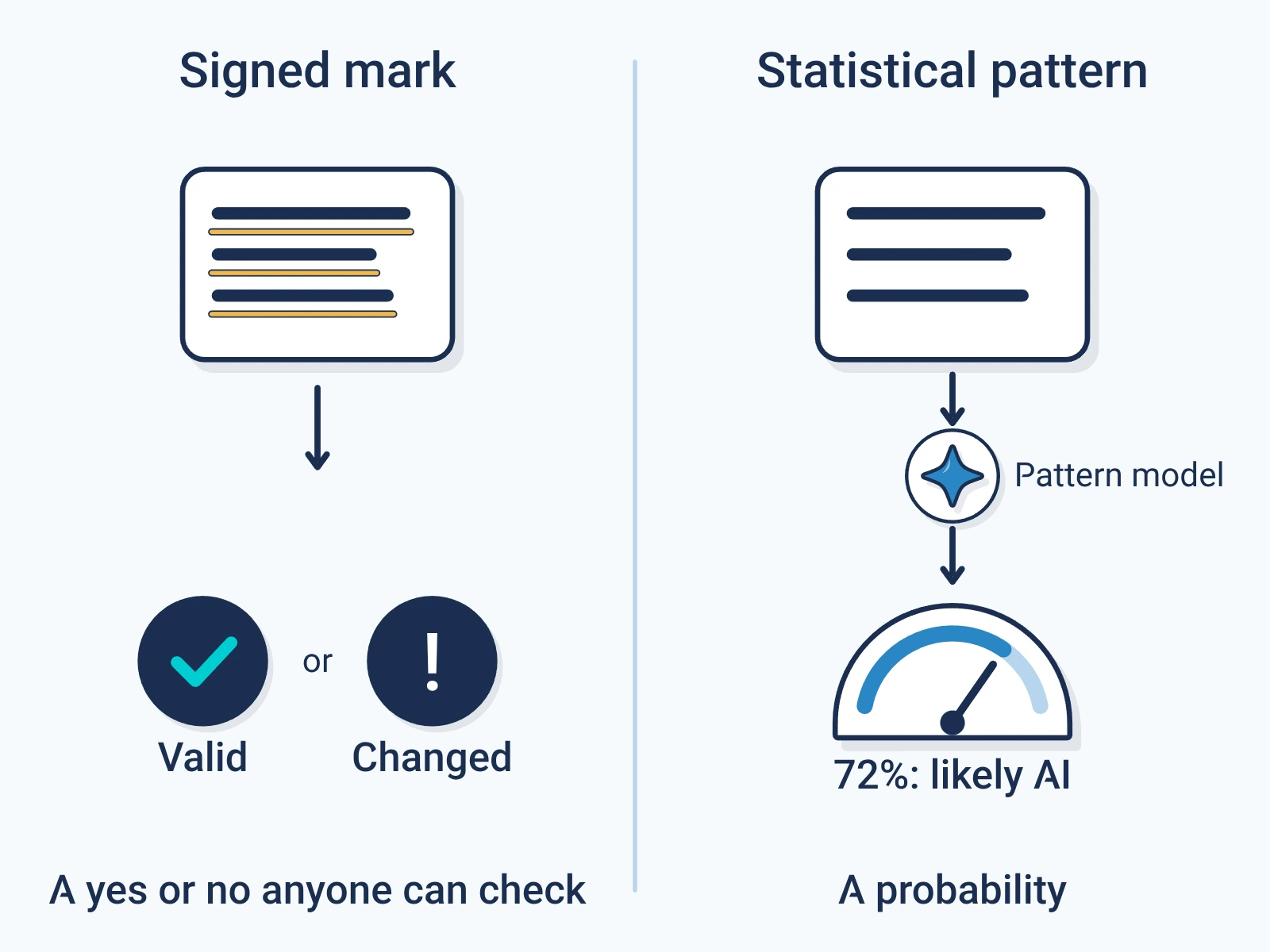
- You do not build separate intake, identity checks and audit for each model and each kind of media.
- One contract checks the provenanceContent provenance: The record of where a piece of content came from and how it changed, carried with the content itself. of text, images, audio, video and documents such as PDF and Word.
- Unlike signals stay unlike. A watermark guess never turns into a signed proof.
Where we stop and your team starts
For the EU AI ActEU AI Act: The European Union's law on artificial intelligence, which includes rules for marking AI-made content., Article 50Article 50: The EU AI Act rule that AI-made content be marked in a form software can read, and deepfakes disclosed., we supply the marking, the checks and the evidence record. Your team and counsel decide which systems are in scope, what people must be told, and how to handle exceptions.
Not sure what is in scope? Run the readiness check.
Read the Article 50 guideFor engineers
Show the technical detailThe endpoints, the bindings and the limits of recovery.
curl -X POST https://api.encypher.com/api/v1/public/verify \
  -H "Content-Type: application/json" \
  -d '{"text": "Paste signed text here."}'
curl -X POST https://api.encypher.com/api/v1/public/verify/media \
-F "file=@photo.jpg"# A file whose embedded record was removed:
# look up the linked record through its soft binding
POST /api/v1/public/verify/soft-binding- Validation
- When a manifest is present, the check covers the credential, certificate chain, signer, timestamp, claims and content binding.
- Recovery
- Recover linked provenance through C2PA soft binding when the applicable watermark and resolver are present and embedded metadata is missing.
- Recovery limits
- A generic watermark is not a C2PA soft binding. Recovery needs the identifier, a resolver, a reachable record and a supported path.
- Reference
- API reference
Create. Mark. Endure.
Start with one output. Send it, read the evidence, then use the same call across your products.